
Catholic Mass Readings and Reflection October 25, 2026
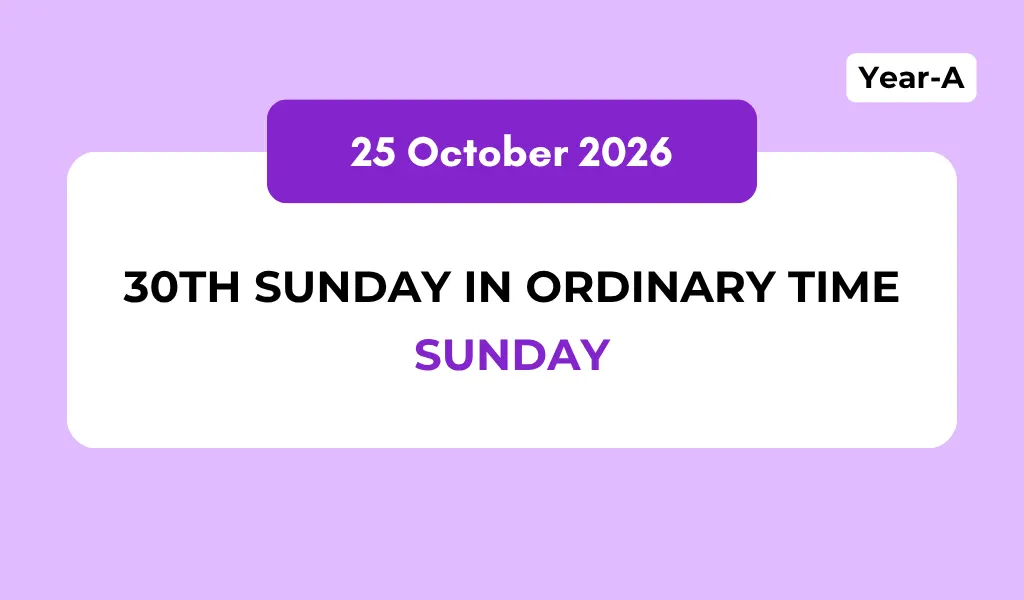
Sunday – 30th Sunday in Ordinary Time
25th October 2026 (Sunday)
Psalter: Week 2
Here are the Catholic Mass readings and a daily Gospel reflection for Sunday, October 25, 2026, the Thirtieth Sunday in Ordinary Time. God warns Israel not to oppress the stranger, the widow, or the poor, Paul praises a faith that turned from idols, and Jesus names the two commandments on which everything hangs.
Catholic Mass Readings
Readings of the Day
First Reading: Exodus 22:20-26
Thus says the Lord: “You shall not wrong a sojourner or oppress him, for you were sojourners in the land of Egypt. You shall not mistreat any widow or fatherless child. If you do mistreat them, and they cry out to me, I will surely hear their cry, and my wrath will burn, and I will kill you with the sword, and your wives shall become widows and your children fatherless. “If you lend money to any of my people with you who is poor, you shall not be like a moneylender to him, and you shall not exact interest from him. If ever you take your neighbor’s cloak in pledge, you shall return it to him before the sun goes down,
Psalm 18:2-3, 3-4, 47, 51 R. (2)
R/. I love you, Lord, my strength
Second Reading: 1 Thessalonians 1:5c-10
Brethren: You know what kind of men we proved to be among you for your sake. And you became imitators of us and of the Lord, for you received the word in much affliction, with the joy of the Holy Spirit, so that you became an example to all the believers in Macedonia and in Achaia. For not only has the word of the Lord sounded forth from you in Macedonia and Achaia, but your faith in God has gone forth everywhere, so that we need not say anything. For they themselves report concerning us the kind of reception we had among you, and how you turned to God from idols to serve the living and true God, and to wait for his Son from heaven, whom he raised from the dead, Jesus who delivers us from the wrath to come.
Gospel Acclamation
V/. Alleluia
R/. Alleluia
V/. If anyone loves me, he will keep my word, says the Lord; and my Father will love him, and we will come to him
R/. Alleluia
Gospel: Matthew 22:34-40
At that time: When the Pharisees heard that he had silenced the Sadducees, they gathered together. And one of them, a lawyer, asked him a question to test him. “Teacher, which is the great commandment in the Law?” And he said to him, “You shall love the Lord your God with all your heart and with all your soul and with all your mind. This is the great and first commandment. And a second is like it: You shall love your neighbor as yourself. On these two commandments depend all the Law and the Prophets.”
Sunday – 30th Sunday in Ordinary Time
Daily Gospel Reflection
Main Point: A lawyer asks which commandment is the greatest. Jesus gives two, and ties them together, and says the whole law and the prophets hang on them. Then the first reading shows exactly what that love looks like on the ground, and it is not sentimental.
1. The Pharisees send an expert to test Him. Teacher, which is the great commandment in the law? Out of six hundred and thirteen commands, which one towers over the rest? It is a scholar’s question, meant to trap. Jesus answers it in a way no one can argue with, and no one can escape.
2. You shall love the Lord your God with all your heart, with all your soul, and with all your mind. This is the great and first commandment. Everything begins here, with God loved wholly, not partly, not politely, but with everything we are. This is the first love, the source of all the rest.
3. And then He does something He was not asked to do. He adds a second. And a second is like it: you shall love your neighbor as yourself. He will not let the first stand alone. He binds them together, because a love for God that does not reach the neighbor is not yet the love He means. The vertical and the horizontal make a cross.
4. On these two commandments, He says, hang all the law and the prophets. Everything God has ever asked, every command, every prophet’s cry, hangs on these two loves like a door on its hinges. Get these two right and the rest follows. Get these wrong and no amount of religious correctness can make up for it.
5. It would be easy to leave this as a beautiful idea, two loves, warm and general. But the first reading refuses to let love stay abstract. God gets specific, and uncomfortably so. You shall not wrong or oppress a stranger, for you were strangers in the land of Egypt. You shall not mistreat a widow or an orphan.
6. Hear how concrete God makes it. If you take your neighbor’s cloak as a pledge for a loan, give it back before sundown, because it is the only blanket he has to sleep in. What else will he sleep in? God asks. Love of neighbor, in God’s own mouth, is not a feeling. It is the returned blanket, the uncheated worker, the protected stranger, the cared-for widow.
7. This is where the Gospel reaches our actual week. Jesus says love your neighbor, and Exodus tells us the neighbor has a face: the migrant with no standing, the single mother barely holding on, the poor man whose only blanket is in our hands. The two great loves are not fulfilled in the abstract. They are fulfilled in how we treat the person with the least power over us.
8. And notice why God gives the reason He does: you were strangers in Egypt. You know what it is to be the vulnerable one, the outsider, the person at someone else’s mercy. Remember that, He says, and let it make you tender. We love the stranger because we were strangers, and because God loved us when we were.
9. This is the order the whole of Scripture insists on. We do not manufacture this love by willpower or by a sense of duty. We love because He first loved us, as Paul’s Thessalonians discovered when they turned from idols to serve the living God. The love of God poured into us is the same love that then flows out to the widow and the stranger. The two loves are finally one current, received from God and passed on.
10. So the greatest commandment is not a lofty abstraction to admire on a Sunday. It is a question about Monday. Whom will you love with the love God has poured into you? The whole law hangs on these two loves, and they come to earth in the most ordinary, concrete mercy: a blanket returned before the cold of night.
My Practice: Love of neighbor has a face this week, the stranger, the overburdened, the one with the least power over you. Name that person, and do one concrete thing for them, not as a feeling but as a returned blanket, because you were once a stranger loved by God.
Prayer
Lord God, Your Son told us the whole law hangs on two loves: to love You with all our heart, and to love our neighbor as ourselves. And then You showed us, in Your own words, that this love is not a feeling but a returned blanket, a protected stranger, a cared-for widow. Forgive us for loving You in the abstract while passing by the person in front of us. Pour Your love into our hearts, so that it flows out to the ones with the least power over us. We were once strangers, and You loved us. Make us tender toward every stranger now, for Your sake. Amen.
Question to Reflect Today
- Love of neighbor has a specific face in your life this week. Who is it, and what concrete thing could you do for them, remembering that you too were once a stranger God loved?
Thank You 🙏🙏🙏
Tags: Daily Mass Reflection, Sunday Reflection, Ordinary Time, Gospel of Matthew, Catholic Mass Readings, October 2026