
Catholic Mass Readings and Reflection August 29, 2026
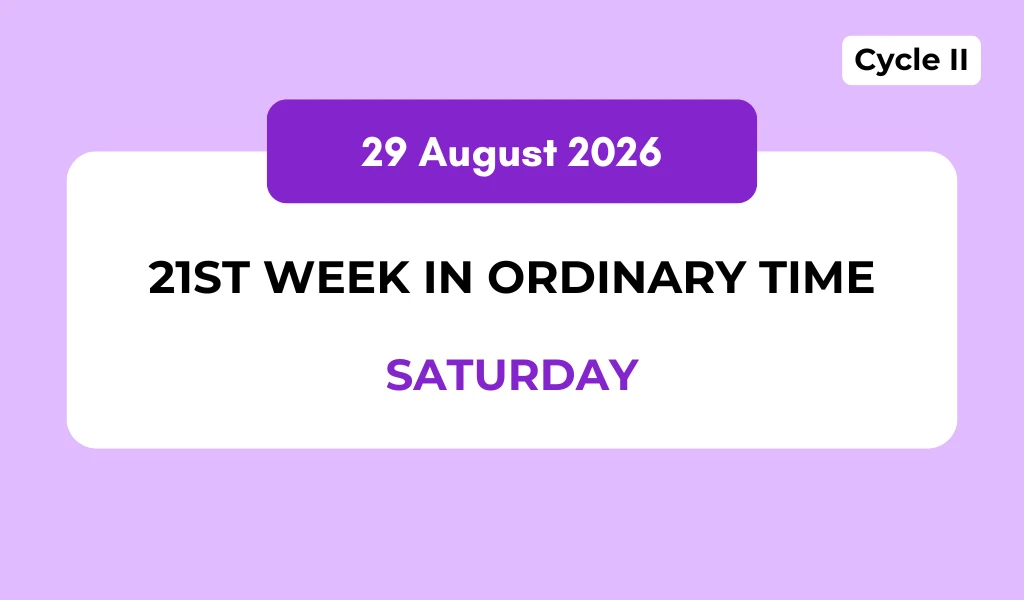
Saturday – 21st Week in Ordinary Time
29th August 2026 (Saturday)
Psalter: Week 1
Here are the Catholic Mass readings and a daily Gospel reflection for Saturday, August 29, 2026, the Memorial of the Passion of Saint John the Baptist. Paul says God chose the weak to shame the strong, and John dies for telling a king the truth.
Catholic Mass Readings
Readings of the Day
First Reading:1 Corinthians 1:26-31
For consider your calling, brothers: not many of you were wise according to worldly standards, not many were powerful, not many were of noble birth. But God chose what is foolish in the world to shame the wise; God chose what is weak in the world to shame the strong; God chose what is low and despised in the world, even things that are not, to bring to nothing things that are, so that no human being might boast in the presence of God. And because of him you are in Christ Jesus, who became to us wisdom from God, righteousness and sanctification and redemption, so that, as it is written, “Let the one who boasts, boast in the Lord.”
Psalm 33:12-13, 18-19, 20-21 (R. 12)
R/. Blessed the people the Lord has chosen as his heritage
Gospel Acclamation
V/. Alleluia
R/. Alleluia
V/. A new commandment I give to you, says the Lord, that you love one another: just as I have loved you
R/. Alleluia
Gospel: Mark 6:17-29
At that time: Herod sent and seized John and bound him in prison for the sake of Herodias, his brother Philip’s wife, because he had married her. For John had been saying to Herod, “It is not lawful for you to have your brother’s wife.” And Herodias had a grudge against him and wanted to put him to death. But she could not, for Herod feared John, knowing that he was a righteous and holy man, and he kept him safe. When he heard him, he was greatly perplexed, and yet he heard him gladly. But an opportunity came when Herod on his birthday gave a banquet for his nobles and military commanders and the leading men of Galilee. For when Herodias’s daughter came in and danced, she pleased Herod and his guests. And the king said to the girl, “Ask me for whatever you wish, and I will give it to you.” And he vowed to her, “Whatever you ask me, I will give you, up to half of my kingdom.” And she went out and said to her mother, “For what should I ask?” And she said, “The head of John the Baptist.” And she came in immediately with haste to the king and asked, saying, “I want you to give me at once the head of John the Baptist on a platter.” And the king was exceedingly sorry, but because of his oaths and his guests he did not want to break his word to her. And immediately the king sent an executioner with orders to bring John’s head. He went and beheaded him in the prison and brought his head on a platter and gave it to the girl, and the girl gave it to her mother. When his disciples heard of it, they came and took his body and laid it in a tomb.
Saturday – 21st Week in Ordinary Time
Daily Gospel Reflection
Main Point: John the Baptist told a king the truth about his marriage, and it cost him his head. His death is a hard reminder that truth spoken to power is dangerous, and still worth speaking.
1. John had told Herod plainly that it was not lawful for him to have his brother’s wife. It was true, and it was costly. Herodias nursed a grudge for it, and Herod, to keep the peace and save face, had John arrested and locked away.
2. Here is the strange part. Herod actually liked to listen to John. Mark says he feared him, knew he was righteous, and was greatly perplexed by him, yet still heard him gladly. A guilty king kept summoning the prophet who disturbed his conscience. Truth fascinated him even as it accused him.
3. Then a party, a dance, and a reckless oath. Herod promises his stepdaughter anything she asks, up to half his kingdom, in front of all his guests. Prompted by her mother, she asks for the head of John the Baptist on a platter. A rash word spoken to impress becomes a death sentence.
4. Watch what traps Herod. He is sorry, Mark tells us. He does not want to kill John. But because of his oaths and his guests, because of who is watching, he does it anyway. He fears looking weak in front of the room more than he fears doing a terrible wrong.
5. That fear is not ancient history. We know the pressure to go along with something we know is wrong because backing down in front of others would cost us face. Herod is a warning. A man can admire the truth, feel its pull, and still betray it to protect his image.
6. John, by contrast, is the man who would not trim the truth to save his life. He was not powerful. He had no army, no title, only a word from God and the courage to say it. And that word outlasted the king who silenced it. Herod is a footnote now. John is a saint.
7. Paul, in the first reading, names exactly this pattern. God chose the weak to shame the strong, the lowly things to bring the mighty to nothing. John looked weak and Herod looked strong, and God’s verdict reversed them both. Faithfulness, not power, is what endures.
My Practice: Find the place where you are tempted to soften the truth to keep face in front of others, and choose honesty there this week, even in something small. Speak the true word, and leave the cost with God.
Prayer
Lord, John the Baptist spoke Your truth to a king and lost his life for it, and he did not flinch. We confess how easily we soften or swallow the truth to protect our image, how much we fear looking weak in front of others. Give us John’s courage, to say what is true and right even when it costs us. Guard us from Herod’s trap, valuing the opinion of the room above what we know is right. You chose the weak to shame the strong; make us faithful rather than impressive. And where speaking truth brings suffering, be our strength, as You were John’s. Amen.
Question to Reflect Today
- Where are you tempted to soften the truth to protect how others see you, and what would faithfulness look like there?
Thank You 🙏🙏🙏
Tags: Daily Mass Reflection, Memorial, John the Baptist, Gospel of Mark, Catholic Mass Readings, August 2026