
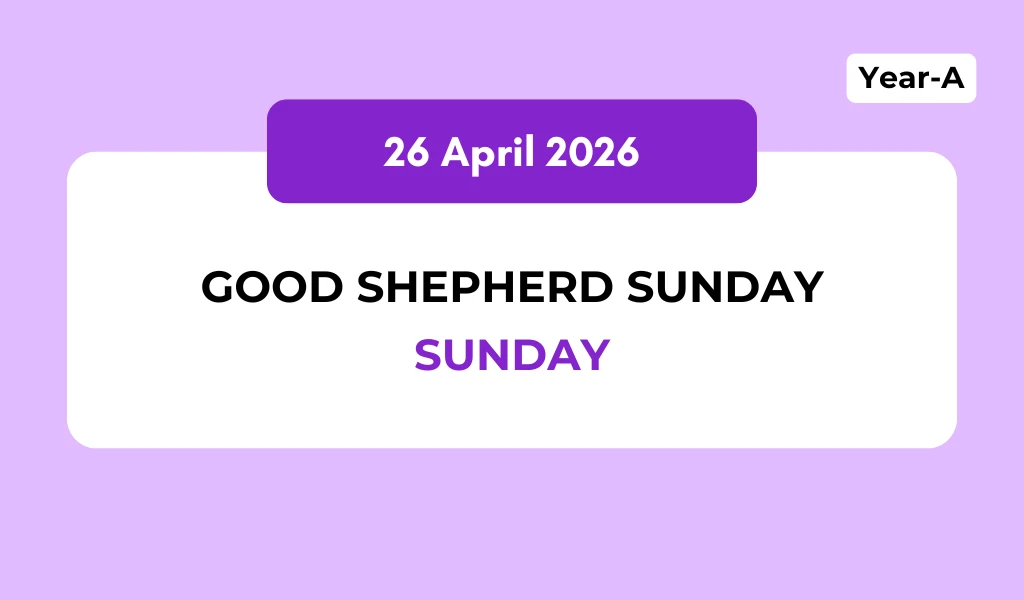
Catholic Mass Readings and Reflection April 26, 2026
Sunday – 4th Sunday of Easter
26th April2026 (Sunday)
Good Shepherd Sunday
Psalter: Week 4
Readings of the Day
First Reading: Acts 2:14a, 36-41
[On the day of Pentecost, Peter, standing with the eleven, lifted up his voice and addressed them: “Let all the house of Israel therefore know for certain that God has made him both Lord and Christ, this Jesus whom you crucified.” Now when they heard this they were cut to the heart, and said to Peter and the rest of the apostles, “Brothers, what shall we do?” And Peter said to them, “Repent and be baptised every one of you in the name of Jesus Christ for the forgiveness of your sins, and you will receive the gift of the Holy Spirit. For the promise is for you and for your children and for all who are far off, everyone whom the Lord our God calls to himself.” And with many other words he bore witness and continued to exhort them, saying, “Save yourselves from this crooked generation.” So those who received his word were baptised, and there were added that day about three thousand souls.

Psalm 23:1-3a, 3b-4, 5, 6 (R.1)
R/. The Lord is my shepherd; there is nothing I shall want. or Alleluia.
Second Reading: 1 Peter 2:20b-25
Beloved: If when you do good and suffer for it you endure, this is a gracious thing in the sight of God. For to this you have been called, because Christ also suffered for you, leaving you an example, so that you might follow in his steps. He committed no sin, neither was deceit found in his mouth. When he was reviled, he did not revile in return; when he suffered, he did not threaten, but continued entrusting himself to him who judges justly. He himself bore our sins in his body on the tree, that we might die to sin and live to righteousness. By his wounds you have been healed. For you were straying like sheep, but have now returned to the Shepherd and Overseer of your souls.
Gospel Acclamation
V/. Alleluia
R/. Alleluia
V/. I am the good shepherd, says the Lord;l know my own, and my own know me.
R/. Alleluia


Gospel: John 10:1-10
At that time: Jesus said, “Truly, truly, I say to you, he who does not enter the sheepfold by the door but climbs in by another way, that man is a thief and a robber. But he who enters by the door is the shepherd of the sheep. To him the gatekeeper opens. The sheep hear his voice, and he calls his own sheep by name and leads them out. When he has brought out all his own, he goes before them, and the sheep follow him, for they know his voice. A stranger. they will not follow, but they will flee from him, for they do not know the voice of strangers.” This figure of speech Jesus used with them, but they did not understand what he was saying to them. So Jesus again said to them, “Truly, truly, I say to you, I am the door of the sheep. All who came before me are thieves and robbers, but the sheep did not listen to them. I am the door. If anyone enters by me, he will be saved and will go in and out and find pasture. The thief comes only. to steal and kill and destroy. I came that they may have life and have it abundantly.
Daily Gospel Reflection
Sunday – 4th Sunday of Easter
Main Point: The virtue of spiritual docility requires us to stop listening to the loud anxieties of the world, because the Good Shepherd can only guide those who are humble enough to recognize His gentle voice.
1. In the Gospel today, Jesus reveals Himself as the Good Shepherd and the very gate of the sheepfold. He explicitly warns us that thieves and robbers are constantly trying to climb over the walls to steal, slaughter, and destroy.
2. We frequently treat this as a comforting, poetic metaphor, but it is actually a severe warning about our daily spiritual warfare. Our minds are constantly invaded by the thieves of worldly ambition, profound insecurity, and relentless anxiety.
3. We stubbornly believe that if we just listen to the loudest, most demanding voices around us—the voices demanding perfection, wealth, or the approval of others—we will finally secure our own happiness. But those false voices only lead to spiritual exhaustion and interior desolation.
4. St. Peter identifies this exact reality in the second reading. He bluntly states that we had all gone astray like wandering sheep. We utterly exhaust ourselves trying to engineer our own salvation and navigate the world relying solely on our own intellect.
5. But the Good Shepherd does not scream, manipulate, or force His way into our lives. Jesus simply states that His sheep recognize His voice and follow Him.
6. Hearing that voice requires a terrifying vulnerability. To recognize the call of the Lord, we must deliberately silence our own frantic attempts to control our circumstances. We must cultivate a profound interior silence.
7. In the first reading, when the crowds hear the truth proclaimed by St. Peter, the Scriptures say they were “cut to the heart.” They do not argue, they do not justify their past sins, and they do not defend their pride.
8. They simply surrender and ask, “What are we to do?”. That is the exact posture of spiritual docility we desperately need today. We must stop pretending we know the best path forward, drop our heavy defenses, and humbly ask the Guardian of our souls to lead us.
9. Jesus promises that He came so that we might have life, and have it more abundantly. However, we must remember that abundant life does not mean a worldly life free from suffering or disappointment.
10. St. Peter reminds us that Christ suffered for us, leaving us a profound example to follow in His exact footsteps. True abundant life is only found when we surrender our stubborn independence and patiently unite our daily crosses to the supreme sacrifice of the Good Shepherd.
My Practice: Cultivate the virtue of spiritual docility today by deliberately silencing the thieves of your peace. Spend ten uninterrupted minutes in absolute silence, completely remove all digital distractions, and humbly ask the Lord for the grace to recognize His voice amidst your worldly anxieties.