

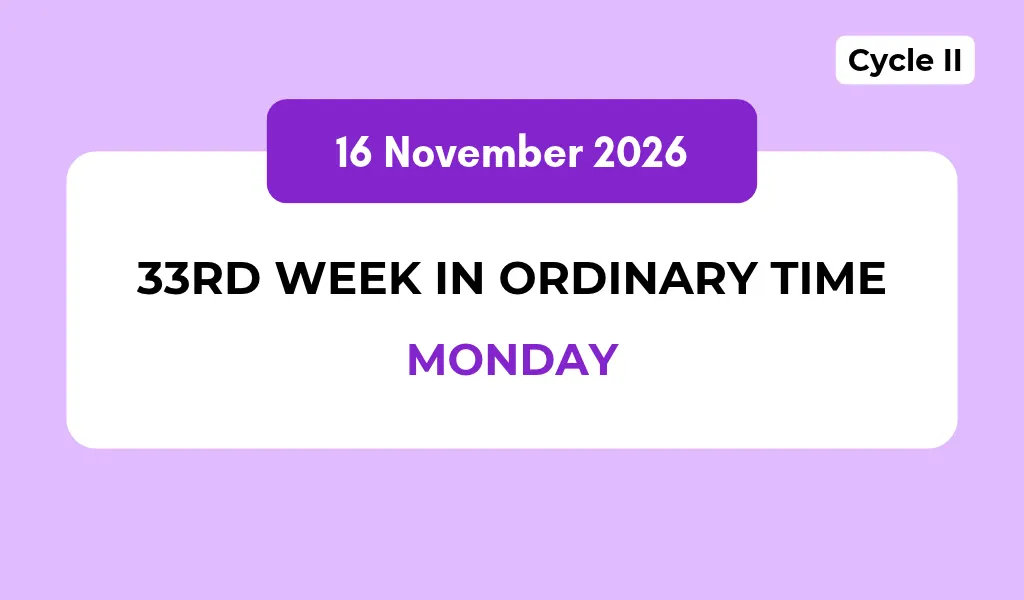
Catholic Mass Readings and Reflection November 16, 2026
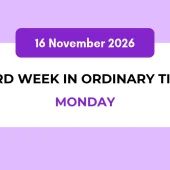
Monday – 33rd Week in Ordinary Time
16th November 2026 (Monday)
Psalter: Week 1
Here are the Catholic Mass readings and a daily Gospel reflection for Monday, November 16, 2026. John receives the revelation of Jesus Christ, and a blind beggar near Jericho calls out to Jesus until he is heard.
Catholic Mass Readings
Readings of the Day
First Reading: Revelation 1:1-4; 2:1-5a
The revelation of Jesus Christ, which God gave him to show to his servants the things that must soon take place. He made it known by sending his angel to his servant John, who bore witness to the word of God and to the testimony of Jesus Christ, even to all that he saw. Blessed is the one who reads aloud the words of this prophecy, and blessed are those who hear, and who keep what is written in it, for the time is near. John to the seven churches that are in Asia: Grace to you and peace from him who is and who was and who is to come, and from the seven spirits who are before his throne. [I heard the Lord saying to me] To the angel of the church in Ephesus write: ‘The words of him who holds the seven stars in his right hand, who walks among the seven golden lampstands.’ I know your works, your toil and your patient endurance, and how you cannot bear with those who are evil, but have tested those who call themselves apostles and are not, and found them to be false. I know you are enduring patiently and bearing up for my name’s sake, and you have not grown weary. But I have this against you, that you have abandoned the love you had at first. Remember therefore from where you have fallen; repent, and do the works you did at first.
Psalm 1:1-2, 3, 4 and 6 (R. Revelation 2:7b)
R/. To the one who conquers, I will grant to eat of the tree of life.
Gospel Acclamation
V/. Alleluia
I am the light of the wold, says the Lord; whoever follows me will have the light of life.
R/. Alleluia
Gospel: Luke 18:35-43
It happened that, as Jesus drew near to Jericho, a blind man was sitting by the roadside begging. And hearing a crowd going by, he inquired what this meant. They told him, “Jesus of Nazareth is passing by.” And he cried out, “Jesus, Son of David, have mercy on me!” And those who were in front rebuked him, telling him to be silent. But he cried out all the more, “Son of David, have mercy on me!” And Jesus stopped and commanded him to be brought to him. And when he came near, he asked him, “What do you want me to do for you?” He said, “Lord, let me recover my sight.” And Jesus said to him, “Recover your sight; your faith has made you well.” And immediately he recovered his sight and followed him, glorifying God. And all the people, when they saw it, gave praise to God.
Monday – 34th Week in Ordinary Time
Daily Gospel Reflection
Main Point: The blind man is the only person on the Jericho road who names his need correctly, and the crowd that can see cannot hear what he says. His cry, “Son of David,” is a confession that Jesus is the promised King, and Luke places it just before the entry into Jerusalem.
1. Luke sets the scene on the road that leads up to Jerusalem. The healing happens near Jericho, the last stop before the Holy City. Throughout Luke 9 to 19 Jesus is walking toward Jerusalem, and every encounter along the road is shaped by that journey. Luke does not describe this man as a passing beggar. He is a man on the edge of the pilgrimage, sitting where the crowds walk by.
2. “Son of David” is a royal title, not just a name. The crowd is hearing a Davidic claim, and the blind man is making it aloud, in public. In the Psalms and the prophets, the Son of David is the messianic king who restores Israel. The beggar, who cannot see the king, recognizes him by title. The seeing crowd calls him quiet, but it is the blind man who speaks the truth about who is passing by.
3. The Greek word for “receive” points to a restoration of sight. When Jesus says “receive your sight,” the Greek verb is anablepō, which means to look up again. The man is not simply given a new faculty. He is restored to the act of lifting his eyes, and in Luke’s Gospel that image of looking up is also the posture of the faithful, who are told to lift up their heads when redemption draws near (Luke 21:28).
4. The rebuke of the crowd echoes the disciples’ earlier mistake. In Luke 18:15 the disciples rebuke parents who bring infants to Jesus, and Jesus says, let the children come. Here the crowd does the same thing: it tries to keep someone away from Jesus. In both scenes Jesus overturns the crowd’s sense of who is worth His time.
5. Jesus’ question is an act of honor, not a formality. “What do you want me to do for you?” is the same question Jesus asks James and John in Mark 10:36. In Luke the question is asked of a man who already knows exactly what he needs, and the answer is simple, “Lord, let me receive my sight.” Jesus treats the request as the beginning of faith, not as an interruption.
6. The conclusion is discipleship, not only healing. The man follows Jesus on the road, glorifying God, and the people who saw it give praise too. Luke’s word for following is the same word used for the disciples who leave everything to walk with Jesus (Luke 5:11). The healed beggar is now on the road to Jerusalem with the disciples, one of the faithful on the way.
My Practice: You might take one honest need you have kept quiet about and write it out in your own words today, as a short prayer. Then read it back slowly and let the question Jesus asked settle into your heart: what do you want me to do for you?
Prayer
Lord Jesus, Son of David, have mercy on us. We have been told to keep quiet about what hurts us, and sometimes we have believed it. Give us the courage of the blind man, who did not stop calling out even when the crowd told him to be silent. Where we think our wounds are too small or too shameful to bring to You, give us the boldness to call out. Stop when we call, and ask us what we truly want. Open our eyes to see You clearly, and let us follow You on the road, giving glory to God. We trust that You hear us. Amen.
Question to Reflect Today
- What honest need have you kept quiet about this week, and what would you say if Jesus asked you directly, “What do you want me to do for you?”
Pray with us: What need have you been keeping quiet about? Share a short prayer intention in the comments below. We offer Holy Mass for every intention shared here each week.
Read tomorrow’s Catholic Mass readings and reflection for November 17, 2026, the Memorial of Saint Elizabeth of Hungary, or revisit yesterday’s reflection for the Thirty-Third Sunday in Ordinary Time.
Amen 🙏🙏🙏
Tags: Daily Mass Reflection, Ordinary Time, Gospel of Luke, Catholic Mass Readings, November 2026




Leave a Feedback