
Catholic Mass Readings and Reflection June 22, 2026
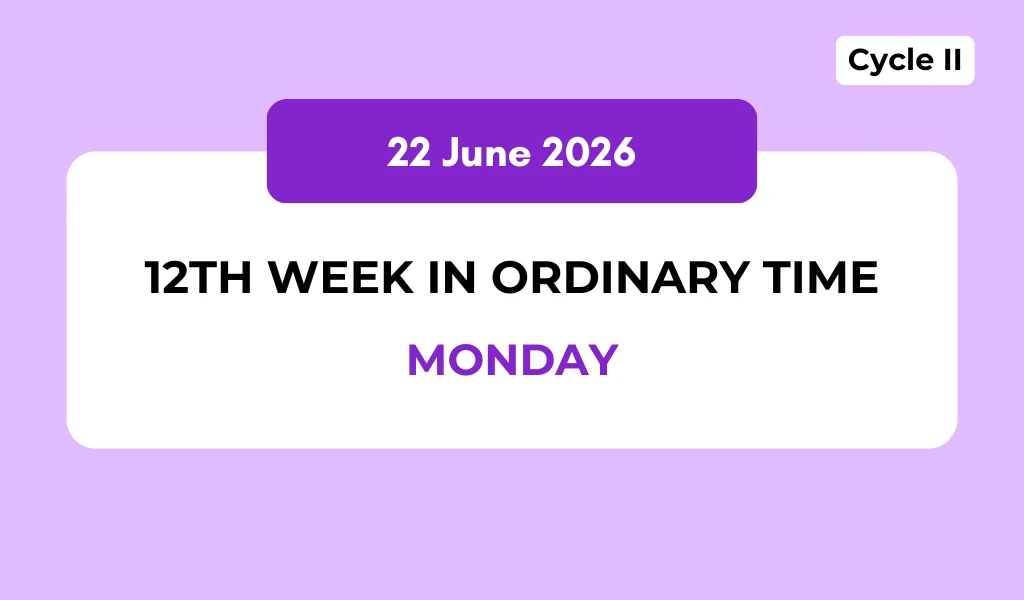
Monday – 12th Week in Ordinary Time
22nd June2026 (Monday)
Psalter: Week 4
Here are the Catholic Mass readings and a daily reflection for Monday, June 22, 2026, an ordinary weekday with the memorials of Saints John Fisher and Thomas More. Today Israel falls because it would not listen, while the Gospel turns the spotlight off our neighbour and back onto us.
Readings of the Day
First Reading: 2 Kings 17:5-8, 13-15a, 18
In those days: Shalmaneser, the king of Assyria invaded all the land and came to Samaria, and for three years he besieged it. In the ninth year of Hoshea, the king of Assyria captured Samaria, and he carried the Israelites away to Assyria and placed them in Halah, and on the Habor, the river of Gozan, and in the cities of the Medes. And this occurred because the people of Israel had sinned against the Lord their God, who had brought them up out of the land of Egypt from under the hand of Pharaoh king of Egypt, and had feared other gods and walked in the customs of the nations whom the Lord drove out before the people of Israel, and in the customs that the kings of Israel had practised. Yet the Lord warned Israel and Judah by every prophet and every seer, saying, “Turn from your evil ways and keep my commandments and my statutes, in accordance with all the Law that I commanded your fathers, and that I sent to you by my servants the prophets.” But they would not listen, but were stubborn, as their fathers had been, who did not believe in the Lord their God. They despised his statutes and his covenant that he made with their fathers and the warnings that he gave them. Therefore the Lord was very angry with Israel and removed them out of his sight. None was left but the tribe of Judah only.
Psalm 60:3, 4-5, 12-14 (R. 7a)
R/. With your right hand, Lord, grant salvation, and give answer.
Gospel Acclamation
V/. Alleluia
R/. Alleluia
V/. The word of God is living and active discerning the thoughts and intentions of the heart.
R/. Alleluia
Gospel: Matthew 7:1-5
At that time: Jesus said to his disciples, “Judge not, that you be not judged. For with the judgment you pronounce you will be judged, and with the measure you use it will be measured to you. Why do you see the speck that is in your brother’s eye, but do not notice the log that is in your own eye? Or how can you say to your brother, ‘Let me take the speck out of your eye’, when there is the log in your own eye? You hypocrite, first take the log out of your own eye, and then you will see clearly to take the speck out of your brother’s eye.
Daily Gospel Reflection
Monday – 12th Week in Ordinary Time
Main Point: We keep a magnifying glass for other people’s faults and a blindfold for our own. Jesus does not tell us to stop seeing. He tells us where to start looking, and it is never with our neighbour.
1. There is a quiet pleasure in spotting what is wrong with someone else. It comes so fast and so easily that we barely notice we are doing it. A look, a comment, a decision made about a person before they have even finished talking. Today the Lord catches us in the act.
2. “Judge not, that you be not judged.” It is a famous line, and often misused. Jesus is not telling us to switch off our conscience or to call every wrong thing good. He is warning us about something else, the quick and proud habit of writing someone off, as if we were God deciding what their soul is worth. We can say an action is wrong. We cannot see into a heart.
3. Then He gives us a picture so silly it should make us laugh at ourselves. A man with a plank sticking out of his own eye, leaning in to pick a tiny speck of dust out of his friend’s eye. He calls that man a hypocrite, a word that first meant an actor, someone wearing a mask. The person who hunts for faults is putting on a show, acting good on the outside while the same trouble hides inside him.
4. Saint Augustine said something simple and sharp about this. We can see what a person does, but we cannot see why they did it. The action is out in the open. The reason is hidden, and only God knows it. This is exactly where most of our harsh opinions go wrong. We guess at reasons we were never allowed to see.
5. The Church gives us a gentle rule for this, one that goes back to Saint Ignatius. Be quicker to take your neighbour’s words in a good way than in a bad one. Before you assume the worst, assume instead that you have not understood yet. That one habit alone would stop half our complaints before they ever reach our lips.
6. The first reading shows what happens to a whole people who will not look at themselves honestly. Israel is carried off into exile, and the writer says plainly why. God had sent prophet after prophet, begging them to turn back, and they simply would not listen. They could see every fault but their own, and in the end the kingdom fell apart.
7. Today’s two saints stand on the opposite side. John Fisher and Thomas More were dragged before an unfair court and condemned by men who simply wanted them gone. Yet Thomas More went to his death without bitterness. He told the very men sentencing him that he hoped they would all meet one day, happily, in heaven. He was judged unfairly, and he refused to judge back. That is the freedom of a man who had already pulled the log out of his own eye.
8. Notice that Jesus never says the speck does not matter. He says take the log out of your own eye first, “and then you will see clearly” to help your brother with his. He is not asking us to go blind to other people. He wants us to see straight, with the kind of clear eyes that can finally help instead of hurt, once our own sight has been fixed.
My Practice: Before you correct anyone today, turn the spotlight around and point it at yourself. The thing that annoys you most in another person is often the very fault you are quietest about in your own life. So name your log, the real one, and take it to confession or to honest prayer before you go reaching for anyone’s speck. A clear eye sees the other person kindly. Fix your own sight first. Then go and help.
Read Yesterday’s Catholic Mass Readings and Reflection June 21, 2026
or