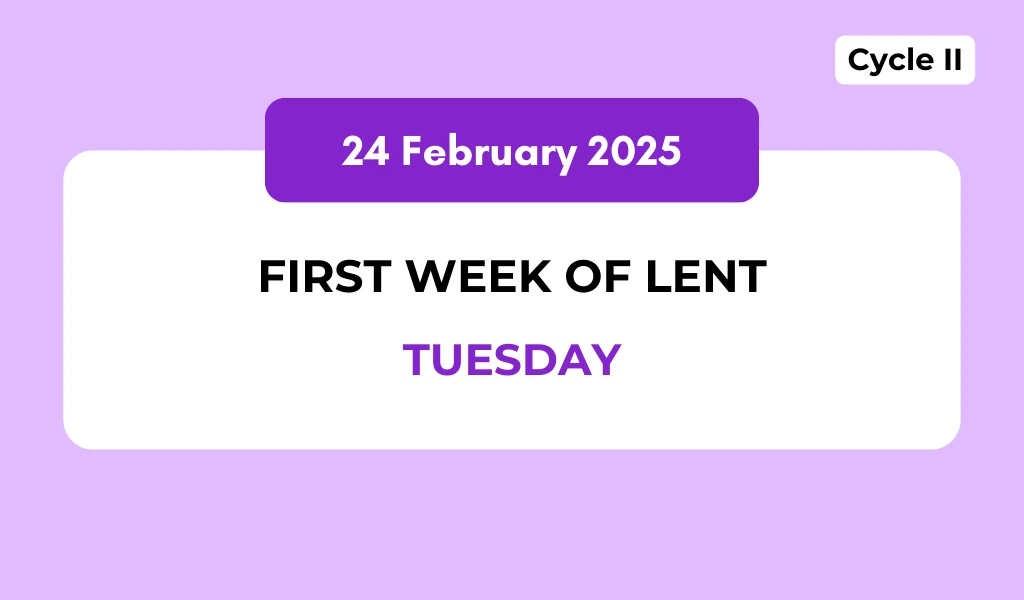

Catholic Mass Readings and Reflection February 24, 2026
Tuesday – First Week of Lent
24th February 2026 (Tuesday)
Psalter: Week 1
Readings of the Day
First Reading: Isaiah 55:10-11
Thus says the Lord: “As the rain and the snow come down from heaven and do not return there but water the earth, making it bring forth and sprout, giving seed to the sower and bread to the eater, so shall my word be that goes out from my mouth; it shall not return to me empty, but it shall accomplish that which I purpose, and shall succeed in the thing for which I sent it.
Psalm 34:4-5, 6-7, 16-17, 18-19, (R. see 18b)
R/. The Lord rescues them in all their distress.
Gospel Acclamation
V/. Glory and praise to you, O Christ
R/. Glory and praise to you, O Christ
V/. Man shall not live by bread alone, but by every word that comes from the mouth of God.
R/. Glory and praise to you, O Christ
Gospel: Matthew 6:7-15
At that time: Jesus said to his disciples, “When you pray, do not heap up empty phrases as the Gentiles do, for they think that they will be heard for their many words. Do not be like them, for your Father knows what you need before you ask him. Pray then like this: “Our Father in heaven, hallowed be your name. Your kingdom come, your will be done, on earth as it is in heaven. Give us this day our daily bread, and forgive us our debts, as we also have forgiven our debtors. And lead us not into temptation, but deliver us from evil. For if you forgive others their trespasses, your heavenly Father will also forgive you, but if you do not forgive others their trespasses, neither will your Father forgive your trespasses.
Daily Gospel Reflection
Tuesday – First Week of Lent
Main Point: Prayer is not an exercise in order making, and it is not about listing out a million requests. Instead, prayer is about remaining silent, and allowing God’s word to settle into our hearts.
1. In the first reading, the prophet Isaiah compares God’s word to the water cycle and describes it in a beautiful manner. He describes how the rain and snow come from heaven, and when they come down, they do not go back up until they have provided water to the earth and nourished the seeds to sprout and grow.
2. God speaks and He describes His word to be rain as well. Whenever God speaks, His word always accomplishes and fulfills Its purpose. It will always be a source of life. However, rain is not able to fall on a hard rock. If our hearts are hard and closed, we will not be able to receive the grace of God. It will simply run off us, and we have to be soft enough to receive the grace of God.
3. In the Gospel, Jesus tells us how to do this. He warns us about how we pray. He says, “Do not heap up empty phrases and do not simply keep talking in hopes that God will finally listen.” At that time, If people talked a lot and used big words, they thought God would finally listen to them.
4. In an honest evaluation of the present and what may have occurred in the past, treating God like a vending machine has merits. This may have involved thinking that God would provide you with what you wanted if you offered a certain predetermined number of prayers. However, in the bible, Jesus states, “Your Father knows what you need before you ask him.”
5. If Jesus already knows what we need, then what is the point of praying? People do not pray to change God”s mind, but to change their own. Prayer is a way of softening one”s own will so that one can be open to receiving the “rain” or graces that God is willing to send to the individual.
6. Jesus left behind the “Our Father” prayer for a very specific reason. In it, one can observe that he did not ask for anything excessive to be given, but was simply asking for a daily supply of the bread that is necessary to sustain life. God is not asking for a million dollars or the perfect life. Jesus asks for enough to sustain one for a single day. This shows that God is indeed not an excess God, but a God of enough, and we can become that kind of person.
7. In the bible, there is what some may consider the most difficult thing to ask of any one person. “Forgive us our trespasses, as we forgive those who trespass against us.” Jesus appears to be setting a rule here. It appears that if one has anger in their heart and refuses to forgive their neighbor, then God”s forgiveness is blocked from him or her. Withholding forgiveness is like setting an umbrella up in a rainstorm. The person who has the umbrella will stay dry, but nothing can grow around them.
My Practice: Which individual am I currently choosing not to forgive? I will today open the “umbrella” of my pride and anger to let God’s mercy rain on my soul.