
Catholic Mass Readings and Reflection August 01, 2026
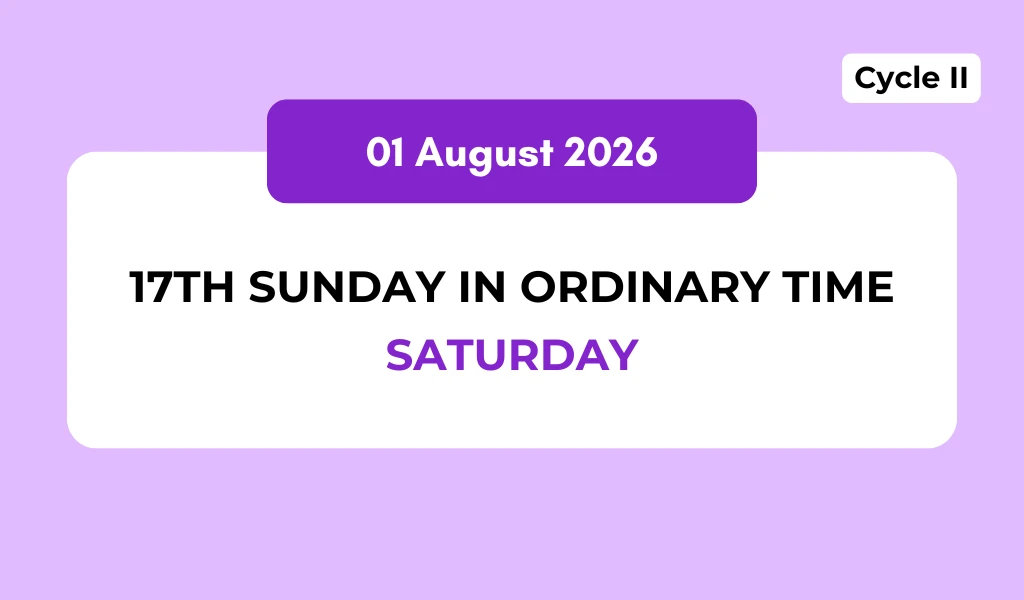
Saturday – 17th Week in Ordinary Time
01st August 2026 (Saturday)
Psalter: Week 1
Here are the Catholic Mass readings and a daily reflection for Saturday, August 01, 2026, the Memorial of Saint Alphonsus Liguori. Jeremiah is spared from death by a few brave men, and in the Gospel Herod executes John the Baptist to save face at a party.
Catholic Mass Readings
Readings of the Day
First Reading: Jeremiah 26:11-16, 24
In those days: The priests and the prophets said to the officials and to all the people, “This man deserves the sentence of death, because he has prophesied against this city, as you have heard with your own ears.” Then Jeremiah spoke to all the officials and all the people, saying, “The Lord sent me to prophesy against this house and this city all the words you have heard. Now therefore mend your ways and your deeds, and obey the voice of the Lord your God, and the Lord will relent of the disaster that he has pronounced against you. But as for me, behold, I am in your hands. Do with me as seems good and right to you. Only know for certain that if you put me to death, you will bring innocent blood upon yourselves and upon this city and its inhabitants, for in truth the Lord sent me to you to speak all these words in your ears.” Then the officia and all the people said to the priests and the prophets, “This man does not deserve the intence of death, for he has spoken to us in the name of the Lord our God.” But the hand of Ahikam the son of Shaphan was with Jemiah so that he was not given over to the cople to be put to death.
Psalm 69:15-16, 30-31, 33-34 (R. see 14)
R/. At an acceptable time, O Lord, answer me
Gospel Acclamation
V/. Alleluia
R/. Alleluia
V/. Blessed are those who are persecuted for righteousness’ sake, for theirs is the kingdom of Heaven
R/. Alleluia
Gospel: Matthew 14:1-12
At that time: Herod the tetrarch heard about the fame of Jesus and he said to his servants, “This is John the Baptist. He has been raised from the dead; that is why these miraculous powers are at work in him.” For Herod had seized John and bound him and put him in prison for the sake of Herodias, his brother Philip’s wife, because John had been saying to him, “It is not lawful for you to have her.” And though he wanted to put him to death, he feared the people, because they held him to be a prophet. But when Herod’s birthday came, the daughter of Herodias danced before the company and pleased Herod, so that he promised with an oath to give her whatever she might ask. Prompted by her mother, she said, “Give me the head of John the Baptist here on a platter.” And the king was sorry, but because of his oaths and his guests he commanded it to be given. He sent and had John beheaded in the prison, and his head was brought on a platter and given to the girl, and she brought it to her mother. And his disciples came and took the body and buried it, and they went and told Jesus.
Saturday – 17th Week in Ordinary Time
Daily Gospel Reflection
Main Point: Herod did not want to kill John. The Gospel says he feared him, protected him, even liked to listen to him. Yet he had him beheaded anyway, over a rash oath at a party, in front of his guests. A man can do terrible things simply because he cannot bear to look weak.
1. Herod throws a birthday banquet, and his court is there, the powerful men of Galilee, watching. His stepdaughter dances, and it pleases him and his guests so much that he makes a wild, showy promise. Ask me for anything, up to half my kingdom, and it is yours. A big man’s boast, made loud for an audience.
2. The girl runs to her mother, Herodias, who has been waiting for exactly this. Herodias hates John the Baptist, because John kept telling Herod that his marriage to her was unlawful. So the mother gives her answer, and the girl comes back with it. Give me the head of John the Baptist, here, on a platter.
3. Now watch Herod carefully, because this is the tragedy. He does not want to do it. The Gospel is explicit. Herod feared John, knowing he was a righteous and holy man. He had even kept him safe. He liked to listen to him, though John’s words disturbed him. Herod is not a man who hated the prophet. He is a man who admired him, and killed him anyway.
4. Why does he do it? The text gives the reason with brutal simplicity. Because of his oaths and his guests. Not conviction. Not even hatred. He is trapped by his own foolish promise and by the faces around the table watching to see what he will do. To take back the oath would look weak in front of his court. So a holy man dies so that a weak man can save face.
5. That is the horror hiding in this story, and it is far more ordinary than murder. Herod knew what was right. He respected the truth. He even enjoyed hearing it. And none of that saved John, because when the moment came, Herod cared more about how he looked than about what was right. His conscience lost to his audience.
6. We would like to think we are nothing like him. But the machinery of Herod’s sin runs in all of us. The cruel thing said because backing down in front of friends felt worse than being cruel. The stand not taken because it would cost us face. The known-wrong thing done because too many people were watching to reverse course now. Herod is not a monster from far away. He is what any of us becomes when we fear looking weak more than we fear doing wrong.
7. And notice, admiring the truth is not the same as obeying it. Herod is proof. He could enjoy John’s preaching for months and still hand over his head in a moment. It is possible to like the word of God, to be moved by it, even to protect it, and still betray it the instant it costs us something in front of the wrong crowd. Enjoyment is cheap. Obedience is the test.
8. Set Jeremiah beside him, because Jeremiah faced the same trap and chose the other way. Dragged before officials and threatened with death, Jeremiah does not soften his message to survive. He tells them plainly, do with me as you see fit, but know that if you kill me you bring innocent blood on yourselves. He would rather die telling the truth than live by swallowing it. Herod broke under the eyes of his guests. Jeremiah stood under the threat of his judges. Same pressure. Opposite men.
9. Saint Alphonsus Liguori spent his life defending consciences caught in exactly these binds. He was a lawyer before he was a priest, and he became the Church’s great moral teacher, gentle with human weakness but clear that we must obey God over the crowd. He founded an order to bring that mercy and that clarity to the poor and forgotten. He would have understood Herod’s cowardice completely, and he would have told him the truth anyway.
My Practice: The next time you are about to do something you know is wrong, stop and ask who you are really afraid of disappointing. Herod killed a holy man rather than look weak in front of his dinner guests, and history has despised him for it ever since. So find the place where you are being pushed to save face at the cost of what is right. The apology you will not make because someone is watching. The truth you will not say because it costs you standing. Break the foolish oath before you break your conscience. It is better to look weak at the table than to carry a righteous man’s blood off it.
Read tomorrow’s Catholic Mass readings and reflection for August 02, 2026, the Eighteenth Sunday in Ordinary Time, or revisit yesterday’s reflection for the Memorial of Saint Ignatius of Loyola.
Thank You 🙏🙏🙏
Tags: Daily Mass Reflection, Ordinary Time, Gospel of Matthew, Catholic Mass Readings, John the Baptist, August 2026