
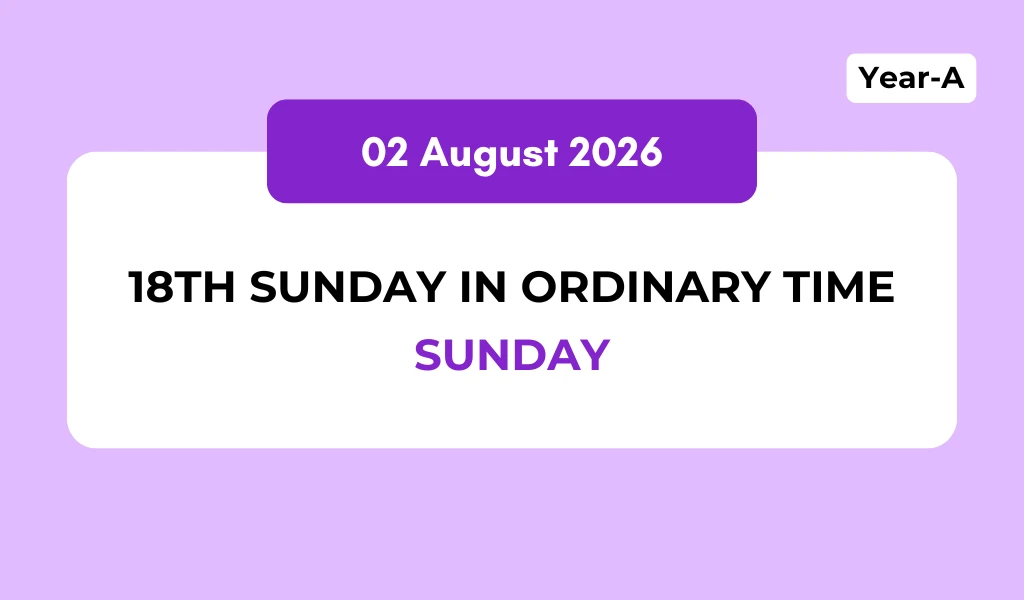
Catholic Mass Readings and Reflection August 02, 2026
Sunday – 18th Sunday in Ordinary Time
02nd August 2026 (Sunday)
Psalter: Week 2
Here are the Catholic Mass readings and a daily reflection for Sunday, August 02, 2026, the Eighteenth Sunday in Ordinary Time. Isaiah invites the hungry to come and eat without money, and in the Gospel Jesus feeds a vast crowd from five loaves and two fish.
Catholic Mass Readings
Readings of the Day
First Reading: Isaiah 55:1-3
“Come, everyone who thirsts, come to the waters; and he who has no money, come, buy and eat! Come, buy wine and milk without money and without price. Why do you spend your money for that which is not bread, and your labor for that which does not satisfy? Listen diligently to me, and eat what is good, and delight yourselves in rich food. Incline your ear, and come to me; hear, that your soul may live; and I will make with you an everlasting covenant, my steadfast, sure love for David.
Psalm 145:8-9, 15-16, 17-18 R. (cf. 16)
R/. You open your hand, Lord, and you satisfy us.
Second Reading: Romans 8:35, 37-39
Who shall separate us from the love of Christ? Shall tribulation, or distress, or persecution, or famine, or nakedness, or danger, or sword? No, in all these things we are more than conquerors through him who loved us. For I am sure that neither death nor life, nor angels nor rulers, nor things present nor things to come, nor powers, nor height nor depth, nor anything else in all creation, will be able to separate us from the love of God in Christ Jesus our Lord.
Gospel Acclamation
V/. Alleluia
R/. Alleluia
V/. Man shall not live by bread alone, but by every word that comes from the mouth of God.
R/. Alleluia
Gospel: Matthew 14:13-21
At that time: When Jesus heard this [of the death of John the Baptist], he withdrew from there in a boat to a desolate place by himself. But when the crowds heard it, they followed him on foot from the towns. When he went ashore he saw a great crowd, and he had compassion on them and healed their sick. Now when it was evening, the disciples came to him and said, “This is a desolate place, and the day is now over; send the crowds away to go into the villages and buy food for themselves.” But Jesus said, “They need not go away; you give them something to eat.” They said to him, “We have only five loaves here and two fish.” And he said, “Bring them here to me.” Then he ordered the crowds to sit down on the grass, and taking the five loaves and the two fish, he looked up to heaven and said a blessing. Then he broke the loaves and gave them to the disciples, and the disciples gave them to the crowds. And they all ate and were satisfied. And they took up twelve baskets full of the broken pieces left over. And those who ate were about five thousand men, besides women and children.
Sunday – 18th Sunday in Ordinary Time
Daily Gospel Reflection
Main Point: Jesus could have made bread from nothing. Instead He asked the disciples for the little they had, five loaves, two fish, and multiplied that. He did not feed the crowd around them. He fed the crowd through them. God still prefers to work with what is placed in His hands.
1. The day begins in grief. Jesus has just heard that John the Baptist is dead, beheaded at Herod’s party, and He withdraws by boat to be alone. But the crowds follow Him on foot around the shore. And here is the first thing to see. He is exhausted and mourning, and still, when He steps off the boat and sees them, He has compassion and heals their sick. He gives from an empty tank.
2. Evening comes, and there is a problem. Thousands of people, far from any village, and no food. The disciples have a sensible, practical solution. Send them away. Let them go buy food for themselves. It is the reasonable thing. It is also the thing that quietly makes the hunger someone else’s problem.
3. Jesus refuses it flatly, and His answer must have stunned them. They need not go away. You give them something to eat. You. A dozen ordinary men, facing thousands of empty stomachs, and Jesus turns and hands the whole impossible task to them. Not, I will handle this. You feed them.
4. Their reply is almost comic in its smallness. We have only five loaves here, and two fish. You can hear the helplessness. This is nothing. This is a boy’s lunch against an ocean of need. It is not even worth bringing up. And that is precisely what Jesus asks them to bring. Bring them here to me.
5. Here is the detail that changes everything, and it is easy to rush past. Jesus does not create bread out of thin air. He could have. He made the universe from nothing. But He does not. He takes the little the disciples actually have, blesses it, breaks it, and gives it back to them to distribute. The miracle flows through their hands, using their five loaves, not around them.
6. Think about what that means. He did not feed the crowd instead of the disciples. He fed the crowd through the disciples. The bread multiplied as they handed it out, not before. They had to start giving away what looked like far too little, and the more they gave, the more there was. The miracle happened in the passing, not in the keeping.
7. This is how God still mostly works. He rarely drops bread from the sky. He asks what you have, your small skill, your little time, your ordinary loaves, and He says bring it to me. We keep waiting for God to fix the hunger around us directly, dramatically, without us. And He keeps turning to us and saying, you give them something to eat. What is in your hands?
8. And notice, He blesses and breaks the bread before it multiplies. It had to be broken to be shared. The loaves did not feed anyone while they were whole and held back. They fed thousands once they were broken open and given away. There is a pattern in that we would rather avoid. What we clutch stays small. What we surrender and let be broken is what God multiplies.
9. Then the number at the end. Twelve baskets of leftovers, one for each disciple. They started by saying we have only five loaves, terrified it was not enough, and ended each holding a full basket. What they gave away came back to them overflowing. You do not run dry by placing your little in His hands. You end up with more than you started, and a crowd is fed besides.
10. This is Isaiah’s invitation made real on a hillside. Come, everyone who thirsts, come to the waters, you who have no money, come, buy and eat. God spreads a table for people who cannot pay. The feeding of the five thousand is that ancient promise walking around in sandals. A God who feeds the hungry for free, and does it, astonishingly, through the barely-enough that ordinary people hand Him.
11. And Paul tells us what this feeding God will never do. Nothing can separate us from His love. Not hardship, not famine, not danger, not death. The hands that multiplied the loaves do not let go. The same generosity that filled twelve baskets holds you through everything that could ever come. You are fed by a love that will not be stopped.
My Practice: Stop waiting for God to fix the hunger around you without you. He almost never works that way. He turns to you, as He turned to the Twelve, and says you give them something to eat. So take the little you keep dismissing as not enough, your ordinary time, your small means, your five loaves, and put it in His hands instead of sending the need away. Let it be blessed. Let it be broken. Then start handing it out before it looks like enough, because the multiplying happens in the giving, never in the keeping. Feed the person in front of you with what you have. God has always preferred to feed His hungry world through the open hands of people who thought they had almost nothing.
Read tomorrow’s Catholic Mass readings and reflection for August 03, 2026, or revisit yesterday’s reflection for the Memorial of Saint Alphonsus Liguori.
Thank You 🙏🙏🙏
Tags: Daily Mass Reflection, Sunday Reflection, Ordinary Time, Gospel of Matthew, Catholic Mass Readings, August 2026