
Catholic Mass Readings and Reflection July 17, 2026
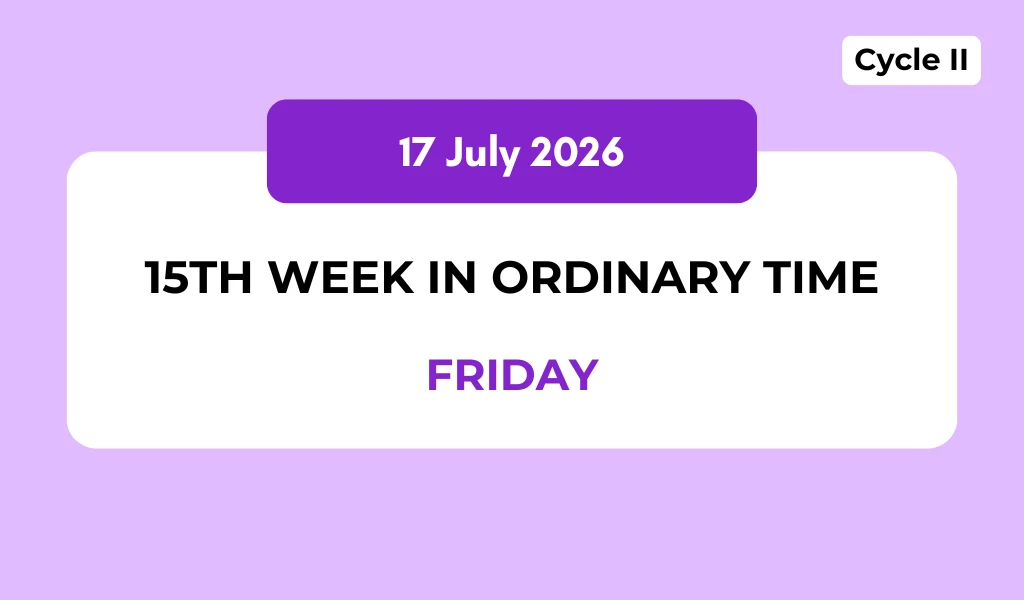
Friday – 15th Week in Ordinary Time
17th July 2026 (Friday)
Psalter: Week 3
Here are the Catholic Mass readings and a daily reflection for Friday, July 17, 2026, an ordinary weekday. A dying king is given fifteen more years, and in the Gospel Jesus defends His hungry disciples and says God desires mercy, not sacrifice.
Catholic Mass Readings
Readings of the Day
First Reading: Isaiah 38:1-6, 21-22, 7-8
In those days, Hezekiah became sick and was at the point of death. And Isaiah the prophet the son of Amoz came to him, and said to him, “Thus says the Lord: Set your house in order, for you shall die, you shall not recover.” Then Hezekiah turned his face to the wall and prayed to the Lord, and said, “Please, O Lord, remember how I have walked before you in faithfulness and with a whole heart, and have done what is good in your sight.” And Hezekiah wept bitterly. Then the word of the Lord came to Isaiah: “Go and say to Hezekiah, Thus says the Lord, the God of David your father: I have heard your prayer; I have seen your tears. Behold, I will add fifteen years to your life. I will deliver you and this city out of the hand of the king of Assyria, and will defend this city. Now Isaiah had said, “Let them take a cake of figs and apply it to the boil, that he may recover.” Hezekiah also had said, “What is the sign that I shall go up to the house of the Lord?” [Isaiah answered,] “This shall be the sign to you from the Lord, that the Lord will do this thing that he has promised: Behold, I will make the shadow cast by the declining sun on the dial of Ahaz turn back ten steps.” So the sun turned back on the dial the ten steps by which it had declined.
Isaiah 38:10, 11, 12abcd, 16 (R. see 17cd)
R/. O Lord, you have delivered my soul lest it perish.
Gospel Acclamation
V/. Alleluia
R/. Alleluia
V/. My sheep hear my voice, says the Lord; and I know them, and they follow me.
R/. Alleluia
Gospel: Matthew 12:1-8
At that time Jesus went through the cornfields on the Sabbath. His disciples were hungry, and they began to pluck ears of corn and to eat. But when the Pharisees saw it, they said to him, “Look, your disciples are doing what is not lawful to do on the Sabbath.” He said to them, “Have you not read what David did when he was hungry, and those who were with him: how he entered the house of God and ate the bread of the Presence, which it was not lawful for him to eat nor for those who were with him, but only for the priests? Or have you not read in the Law how on the Sabbath the priests in the temple profane the Sabbath and are guiltless? I tell you, something greater than the temple is here. And if you had known what this means, ‘I desire mercy, and not sacrifice,’ you would not have condemned the guiltless. For the Son of Man is lord of the Sabbath.”
Friday – 15th Week in Ordinary Time
Daily Gospel Reflection
Main Point: The Pharisees can quote the rule but miss the person. Jesus quotes back one line, I desire mercy, not sacrifice. God never wanted our religion at the expense of compassion. He wants both, but mercy comes first.
1. The disciples are hungry. As they walk through a grain field on the Sabbath, they pick heads of grain and eat. A small, human thing. But the Pharisees pounce. “Your disciples are doing what is not lawful on the Sabbath.” The rule has been broken, and that is all they can see.
2. Notice what they are doing. They see a law bent and miss the hungry men in front of them. Their eyes are on the rule, not the people. This is the danger of a certain kind of religion. It can watch a person suffer and only ask whether procedure was followed.
3. Jesus answers them on their own ground. He reminds them that David, when he and his men were hungry, ate the holy bread reserved for priests. Scripture itself shows human need outweighing ritual rule. The Pharisees know the story. They just never let it teach them.
4. Then He quotes the line that cuts to the heart. “If you had known what this means, I desire mercy, and not sacrifice, you would not have condemned the guiltless.” He is quoting the prophet Hosea. God said it centuries before. Worship that crushes people is not the worship He wants.
5. Sit with those words. “I desire mercy, not sacrifice.” God is not against the Sabbath or the offerings. He gave them. But when rule and mercy collide, mercy wins. A religion that forgets this has missed the very heart of the God it claims to serve.
6. Then Jesus makes a staggering claim. “The Son of Man is lord of the Sabbath.” The Sabbath belongs to God. So by calling Himself its Lord, Jesus is quietly saying who He is. He does not break the Sabbath. He reveals what it was always for. The day was made to give life, not to crush it.
7. This searches us too. It is easy to be strict about our religious habits and cold toward actual people. To judge the person who worships differently. To care more that a rule was kept than that a heart was helped. Jesus warns us off that road. Mercy is not the enemy of holiness. It is its center.
8. This is the thread to Isaiah. King Hezekiah is dying, and he cries out to God. And God, moved by his tears, gives him fifteen more years of life. Here is “mercy, not sacrifice” in action. God bends toward a weeping man and grants him life. The God of the first reading is the God of the Gospel. Mercy is who He is.
My Practice: Find the place where you hide behind a rule to avoid showing mercy. The grudge you justify. The person you correct instead of help. The letter of the law you use to excuse a cold heart. Jesus quotes one line at you today. I desire mercy, not sacrifice. So choose the person over the procedure this time. Keep the good rules, but never let them become a wall against compassion. Mercy is not softness. It is the heart of God.
Read tomorrow’s Catholic Mass readings and reflection for July 18, 2026, or revisit yesterday’s reflection for the Memorial of Our Lady of Mount Carmel.
Thank You 🙏🙏🙏
Tags: Daily Mass Reflection, Ordinary Time, Gospel of Matthew, Catholic Mass Readings, July 2026