
Catholic Mass Readings and Reflection June 18, 2026
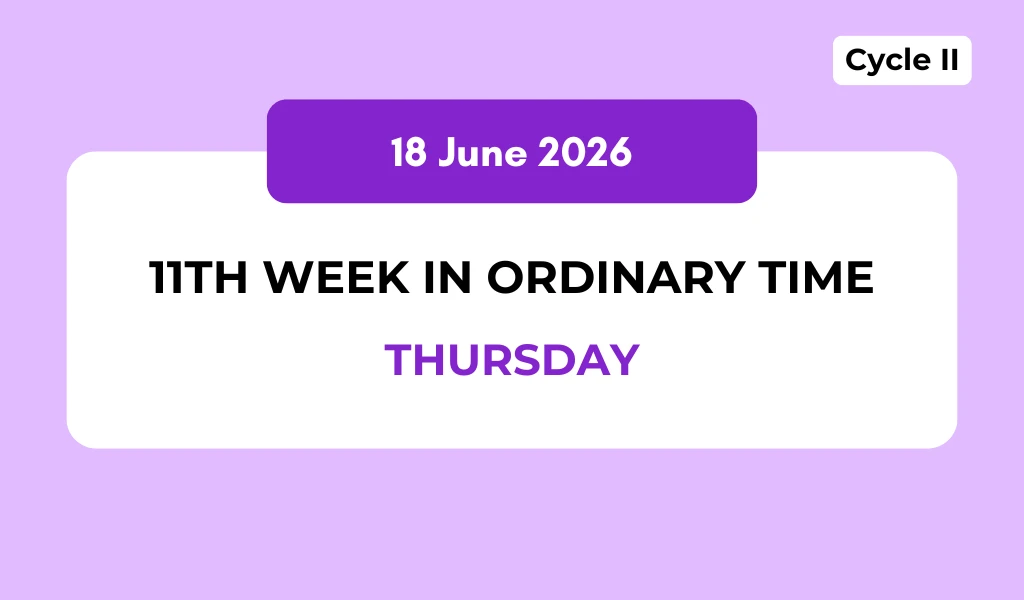
Thursday – 11th Week in Ordinary Time
18th June2026 (Thursday)
Psalter: Week 3
Here are the Catholic Mass readings and a daily reflection for Thursday, June 18, 2026, an ordinary weekday. Today Sirach praises the prophets Elijah and Elisha, while in the Gospel Jesus teaches us how to pray and gives us the Our Father.


Readings of the Day
First Reading: Sirach 48:1-14
The prophet Elijah arose like a fire and his word burned like a torch. He brought a famine upon them, and by his zeal he made them few in number. By the word of the Lord he shut up the heavens, and also three times brought down fire. How glorious you were, O Elijah, in your wondrous deeds! And who has the right to boast that which you have? You who raised a corpse from death and from Hades, by the word of the Most High; who brought kings down to destruction and famous men from their beds; who heard rebuke at Sinai and judgements of vengeance at Horeb; who anointed kings to inflict retribution and prophets to succeed you. You who were taken up by a whirlwind of fire in a chariot with horses of fire; you who are ready at the appointed time, it is written, to calm the wrath of God before it breaks out in fury, to turn the heart of the father to the son, and to restore the tribes of Jacob. Blessed are those who saw you and those who have been fallen asleep in love; for we also shall surely live. It was Elijah who was covered by the whirlwind, and Elisha was filled with his spirit; he performed twice as many signs and marvels with every utterance of his mouth. In all his days he did not tremble before any ruler, and no one brought him into subjection. Nothing was too hard for him, and when he was dead his body prophesied. As in his life he did wonders, so in death his deeds were marvellous.
Psalm 97:1-2, 3-4, 5-6, 7 (R. 12a)
R/. Rejoice in the Lord, you just.
Gospel Acclamation
V/. Alleluia
R/. Alleluia
V/. You have received the Spirit of adoption as sons, by whom we cry, “Abba! Father!”
R/. Alleluia


Gospel: Matthew 6:7-15
At that time: Jesus said to his disciples, “When you pray, do not heap up empty phrases as the Gentiles do, for they think that they will be heard for their many words. Do not be like them, for your Father knows what you need before you ask him. Pray then like this: “Our Father in heaven, hallowed be your name. Your kingdom come, your will be done, on earth as it is in heaven. Give us this day our daily bread, and forgive us our debts, as we also have forgiven our debtors. And lead us not into temptation, but deliver us from evil. For if you forgive others their trespasses, your heavenly Father will also forgive you, but if you do not forgive others their trespasses, neither will your Father forgive your trespasses.
Daily Gospel Reflection
Thursday – 11th Week in Ordinary Time
Main Point: Jesus does not want our prayer buried under a pile of words. He wants our heart. Today He hands us the perfect prayer, and hidden inside it is one condition we would rather skip.
1. We often treat prayer as if God needed convincing. Pile up enough words, repeat them often enough, and maybe He will finally listen. Jesus gently pulls that idea apart today. Our Father is not won over by the length of our speeches.
2. “When you pray, do not heap up empty phrases as the Gentiles do, for they think they will be heard for their many words.” Then the line that changes everything. “Your Father knows what you need before you ask Him.” He already knows. So prayer is not informing God. It is opening ourselves to the One who already sees.
3. Then Jesus does something extraordinary. He gives us the words Himself. Not a vague suggestion to pray however we like, but a real prayer, the Our Father, the model for every prayer we will ever pray. When we are lost for words, He has already given us the ones that matter.
4. Look at how it begins. “Our Father in heaven, hallowed be your name.” Before a single request for ourselves, the prayer lifts its eyes to God. His name, His kingdom, His will come first. We so easily rush to our shopping list of needs. Jesus teaches us to start with God, not with self.
5. “Your will be done, on earth as it is in heaven.” This is the hardest line in the prayer, and the most freeing. We are not bending God’s will toward ours. We are bending ours toward His. Real prayer slowly stops trying to change God’s mind and starts surrendering our own.
6. Only then does it turn to us, and even then the needs are simple. Daily bread, enough for today, not a storehouse for a worried future. Forgiveness. Protection from the evil one. No empty phrases, no padding. Just the honest, essential cries of a child who trusts his Father.
7. But notice the one petition Jesus circles back to after the prayer ends. Not bread. Not temptation. Forgiveness. “Forgive us our debts, as we also have forgiven our debtors.” And then He spells out the catch we would rather not hear. If we do not forgive others, our Father will not forgive us.
8. That should stop us where we stand. The mercy we want from God is tied, by His own words, to the mercy we are willing to give. We cannot clutch a grudge in one hand and reach for forgiveness with the other. The prayer we love so much quietly asks us to let someone off the hook.
9. Sirach gives us prophets who prayed with exactly that kind of fire and trust. Elijah’s word brought down fire from heaven, and Elisha carried a double portion of his spirit. They did not bury God in words. They knew Him, leaned on Him, and their prayers moved heaven because their hearts were wholly His.
My Practice: Pray the Our Father slowly today, one line at a time, as though you had never heard it before. But when you reach “as we forgive those who trespass against us,” stop. Do not say it lightly. Name the person you have been refusing to forgive, and decide, right there, whether you mean the words or not. Then either forgive them, or stop pretending the rest of the prayer costs you nothing.
Read Yesterday’s Catholic Mass Readings and Reflection June 17, 2026
or