
Catholic Mass Readings and Reflection June 11, 2026
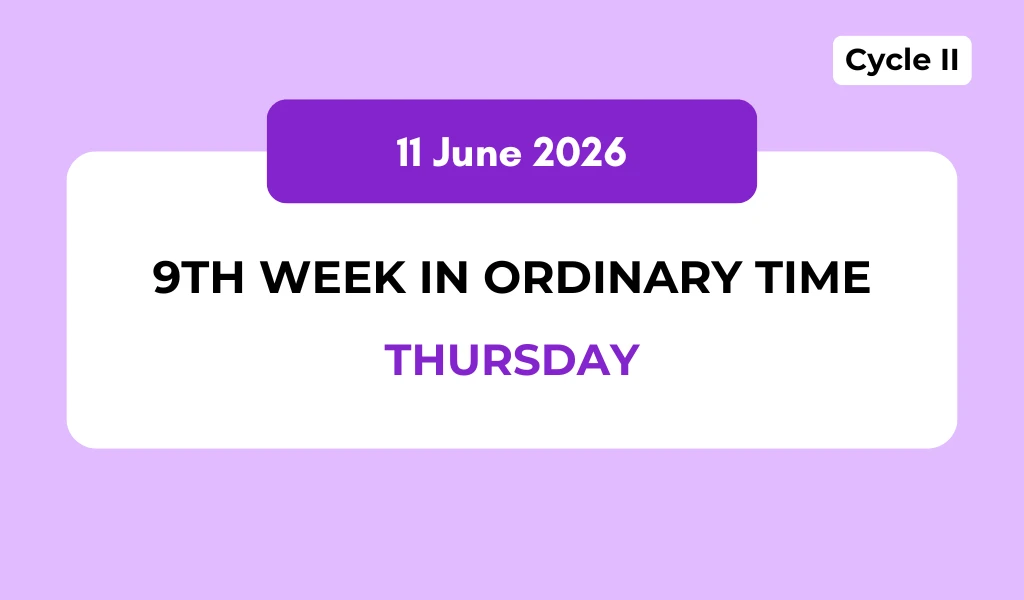
Thursday – 11th Week in Ordinary Time
11th June2026 (Thursday)
Psalter: Week 2
Readings of the Day
First Reading: Acts 11:21b-26; 13:1-3
In those days: A great number who believed turned to the Lord. The report of this came to the ears of the church in Jerusalem, and they sent Barnabas to Antioch. When he came and saw the grace of God, he was glad, and he exhorted them all to remain faithful to the Lord with steadfast purpose, for he was a good man, full of the Holy Spirit and of faith. And a great many people were added to the Lord. So Barnabas went to Tarsus to look for Saul, and when he had found him, he brought him to Antioch. For a whole year they met with the church and taught a great many people. And in Antioch the disciples were first called Christians. Now there were in the church at Antioch prophets and teachers, Barnabas, Simeon who was called Niger, Lucius of Cyrene, Manaen a lifelong friend of Herod the tetrarch, and Saul. While they were worshipping the Lord and fasting, the Holy Spirit said, “Set apart for me Barnabas and Saul for the work to which I have called them.” Then after fasting and praying they laid their hands on them and sent them off.


Psalm 98:1, 2-3ab, 3cd-4, 5-6 (R. 2b)
R/. The Lord has shown his deliverance to the nations
Gospel Acclamation
V/. Alleluia
R/. Alleluia
V/. Go and make disciples of all nations, says the Lord I am with you always, to the end of the age. R/. Alleluia.
R/. Alleluia
Gospel: Matthew 10:7-13
At that time: Jesus said to his apostles, “Proclaim as you go, saying, ‘The kingdom of heaven is at hand.’ Heal the sick, raise the dead, cleanse lepers, cast out demons. You received without paying; give without pay. Acquire no gold or silver or copper for your belts, no bag for your journey, or two tunics or sandals or a staff, for the labourer deserves his food. And whatever town or village you enter, find out who is worthy in it and stay there until you depart. As you enter the house, greet it. And if the house is worthy, let your peace come upon it, but if it is not worthy, let your peace return to you.


Daily Gospel Reflection
Thursday – 10th Week in Ordinary Time
Main Point: Jesus will not accept worship from hands that hold a grudge. Before the gift on the altar comes the harder task of reconciling with a brother. And Barnabas shows us what a heart bent on building others up looks like.
1. We like to think our worship and our relationships are two separate accounts. One is between us and God, the other between us and people, and the two need not touch. Today Jesus tears down that wall and tells us they were never separate at all.
2. He sets the bar startlingly high. “Unless your righteousness exceeds that of the scribes and Pharisees, you will never enter the kingdom of heaven.” The scribes kept the rules flawlessly. So Jesus is saying that mere rule keeping is not enough. He is after something deeper than a clean record.
3. Then He shows us what He means. The old law said do not kill. But Jesus reaches behind the act to the heart. Whoever nurses anger against his brother, whoever spits out insults and contempt, is already guilty. The murder begins long before the hand moves. It begins in the cold, unforgiving heart.
4. And here comes the line that should stop us at the church door. “If you bring your gift to the altar and there remember your brother has something against you, leave your gift, go, be reconciled, and then come and offer it.” First make peace. Then worship. Not the other way round.
5. Read that again slowly. Jesus tells us to interrupt our offering, to walk away from the altar itself, and go mend the broken relationship first. He would rather we leave Mass to forgive a brother than stay and pray with a heart full of poison. Reconciliation is not optional. It comes first.
6. This is where so much of our religion quietly fails. We keep our prayers and our practices polished while harbouring grudges for years. We come forward for communion still refusing to speak to a relative, a neighbour, a fellow parishioner. We offer God clean hands and a bitter heart, and wonder why we feel nothing.
7. Saint Barnabas is the living answer to that bitterness. His name means “son of encouragement,” and he earned it. When the others were afraid of the newly converted Paul, it was Barnabas who took him in and vouched for him. Where others saw a threat, he chose to build a bridge.
8. Look at what that one act of trust unleashed. Barnabas sought Paul out, brought him to Antioch, and together they taught crowds and launched the mission that would carry the Gospel across the world. A heart willing to reconcile and encourage does not just keep the peace. It changes history.
My Practice: Who is the person you have been worshipping around instead of making peace with? You know the name. Jesus says leave the gift at the altar and go to them first. So before your next Mass, make the call, send the message, take the step you have been avoiding for far too long. God can wait at the altar. He would rather you arrive with empty hands and a reconciled heart than full hands and an icy one.