
Catholic Mass Readings and Reflection June 07, 2026
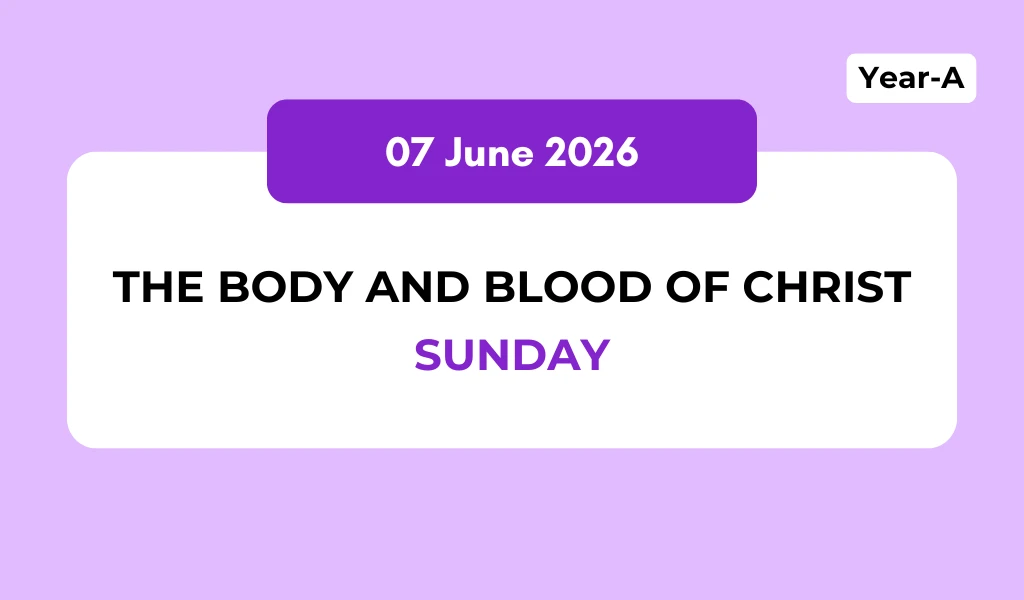
Sunday – The Body and Blood of Christ
07th June2026 (Sunday)
Psalter: Proper
Readings of the Day
First Reading: Deuteronomy 8:2-3, 14b-16a
Moses spoke to the people, saying, You shall remember the whole way that the Lord your God has led you these forty years in the wilderness, that he might humble you, testing you to know what was in your heart, whether you would keep his commandments or not. And he humbled you and let you hunger and fed you with manna, which you did not know, nor did your fathers know, that he might make you know that man does not live by bread alone, but man lives by every word that comes from the mouth of the Lord. “Take care lest you forget the Lord your God, who brought you out of the land of Egypt, out of the house of slavery, who led you through the great and terrifying wilderness, with its fiery serpents and scorpions and thirsty ground where there was no water, who brought you water out of the flinty rock, who fed you in the wilderness with manna that your fathers did not know.
Psalm 147:12-13, 14-15, 19-20 (12a)
R/. O Jerusalem, glorify the Lord! or: Alleluia.
Second Reading: 1 Corinthians 10:16-17
Brethren: The cup of blessing that we bless, is it not a participation in the blood of Christ? The bread that we break, is it not a participation in the body of Christ? Because there is one bread, we who are many are one body, for we all partake of the one bread.
Gospel Acclamation
V/. Alleluia
R/. Alleluia
V/. I am the living bread that came down from heaven. says the Lord; If anyone eats of this bread, he will live for ever.
R/. Alleluia
Gospel: John 6:51-58
At that time: Jesus said to the crowds of the Jews, “I am the living bread that came down from heaven. If anyone eats of this bread, he will live for ever. And the bread that I will give for the life of the world is my flesh.” The Jews then disputed among themselves, saying, “How can this man give us his flesh to eat?” So Jesus said to them, “Truly, truly, I say to you, unless you eat the flesh of the Son of Man and drink his blood, you have no life in you. Whoever eats my flesh and drinks my blood has eternal life, and I will raise him up on the last day. For my flesh is true food, and my blood is true drink. Whoever feeds on my flesh and drinks my blood abides in me, and I in him.. As the living Father sent me, and I live because of the Father, so whoever feeds on me, he also will live because of me. This is the bread that came down from heaven, not like the bread the fathers ate, and died. Whoever feeds on this bread will live for ever.
Daily Gospel Reflection
Sunday – The Body and Blood of Christ
Main Point: God does not feed us with words alone. On this feast He gives us His own Body and Blood, real food for a real hunger, and asks the only question that matters. Will we receive Him, or merely look on?
1. Hunger is the most honest thing in us. We can hide many needs, but not this one. When the body is empty, it cries out, and no amount of pretending will silence it. Today’s feast speaks straight to a hunger far deeper than any meal can reach.
2. Moses takes us back to the wilderness first. For forty years God led His people through a barren land, and when they were starving, He rained down manna from heaven. He fed them, but He also taught them why. “Man does not live by bread alone, but by every word from the mouth of God.”
3. That manna was a gift, but it was only a shadow. It filled their stomachs for a day, and then they were hungry again. Those who ate it still died in the desert. God was preparing them, and us, for a bread that does far more than keep us alive for an afternoon.
4. Then in the Gospel Jesus says the words that scandalised His listeners and still unsettle us. “I am the living bread that came down from heaven.” And He goes further. “The bread that I will give is my flesh for the life of the world.” He is no longer speaking of manna. He is speaking of Himself.
5. The crowd reacts exactly as we might. “How can this man give us his flesh to eat?” They argue among themselves. And here is the striking thing. Jesus does not soften His words to calm them down. He does not say He was only speaking in symbols. He says it again, more strongly.
6. “Unless you eat the flesh of the Son of Man and drink his blood, you have no life in you.” This is not a gentle suggestion. It is the very source of life. Jesus is telling us plainly that He means to feed us with Himself, and that we cannot truly live without Him.
7. Notice the words He chooses. “My flesh is true food, and my blood is true drink.” Not pretend food. Not a nice idea or a fond memory. The Eucharist is not a symbol we look at from a distance. It is the Lord Himself, given to us, taken into us, made one with us.
8. Paul, in the second reading, draws out what this means for us together. “The bread that we break, is it not a sharing in the body of Christ?” And then the line we so easily skip past. “Because there is one bread, we who are many are one body.”
9. Think about what that says. The same Christ we receive, your neighbour receives. The person beside you in the pew, the one you find difficult, the one you have not spoken to in years, eats the same Lord you do. We cannot be one with Christ and divided from each other.
10. This is why how we live and how we receive cannot be separated. We come forward, hold out our hands, and say “Amen” to the Body of Christ. But that “Amen” is a promise. It says, I believe this is the Lord, and I will let Him change me.
11. And yet how often do we receive Him as though it were nothing? We line up out of habit, our minds wandering to lunch and to our plans, and we take the Bread of Life as casually as we would take any snack. The greatest gift in the world, handled with the smallest attention.
12. Moses warned the people of exactly this danger. When you are full and settled, he said, do not forget the Lord who fed you. Comfort makes us careless. The more easily the gift comes to us, the more quickly we stop seeing how precious it is.
13. So this feast is a summons to wake up. Heaven has come down and placed itself in our hands. The God who made the stars hides Himself under the form of bread so that we, small and hungry, can carry Him within us. This is not ordinary. This is everything.
My Practice: Think back to how you last came forward. Were your hands truly open, or only your habits? This is no mere bread. It is the living God, hiding in something small enough for you to carry. So the next time you say “Amen” at this altar, mean it. Receive Him as though it were your first time and your last. Then carry Him out the door, all the way to the neighbour you find hardest to love. In this Bread you have become one body with them. Go and live like you believe it.