
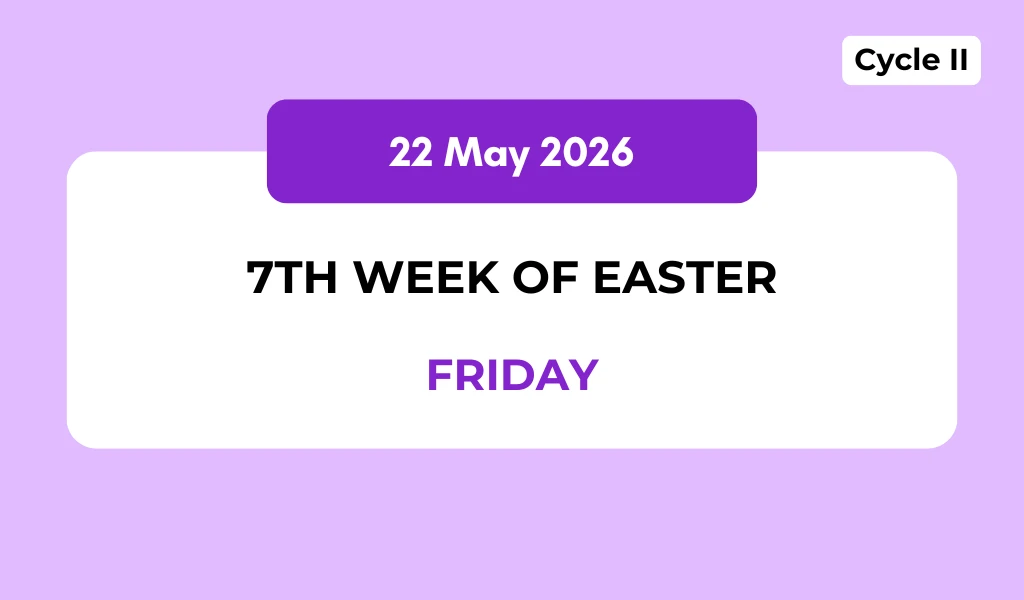
Catholic Mass Readings and Reflection May 22, 2026
Friday – 7th Week of Easter
22nd May2026 (Friday)
Psalter: Week 3
Readings of the Day
First Reading: Acts 25:13b-21
In those days: Agrippa the king and Bernice arrived at Caesarea and greeted Festus. And as they stayed there many days, Festus laid Paul’s case before the king, saying, “There is a man left prisoner by Felix, and when I was at Jerusalem, the chief priests and the elders of the Jews laid out their case against him, asking for a sentence of condemnation against him. I answered them that it was not the custom of the Romans to give up anyone before the accused met the accusers face to face and had opportunity to make his defense concerning the charge laid against him. So when they came together here, I made no delay, but on the next day took my seat on the tribunal and ordered the man to be brought. When the accusers stood up, they brought no charge in his case of such evils as I supposed. Rather they had certain points of dispute with him about their own religion and about a certain Jesus, who was dead, but whom Paul asserted to be alive. Being at a loss how to investigate these questions, I asked whether he wanted to go to Jerusalem and be tried there regarding them. But when Paul had appealed to be kept in custody for the decision of the emperor, I ordered him to be held until I could send him to Caesar.”

Psalm 103:1-2, 11-12, 19-20ab R. (19a)
R/. The Lord has fixed his throne in heaven. Or: Alleluia.
Gospel Acclamation
V/. Alleluia
R/. Alleluia
V/. The Holy Spirit will teach you all things and bring to your remembrance all that I have said to you.
R/. Alleluia
Gospel: John 21:15-19
When, [Jesus had revealed himself to his disciples and] they had finished breakfast, Jesus said to Simon Peter, “Simon, son of John, do you love me more than these?” He said to him, “Yes, Lord; you know that I love you.” He said to him, “Feed my lambs.” He said to him a second time, “Simon, son of John, do you love me?” He said to him, “Yes, Lord; you know that I love you.” He said to him, “Tend my sheep.” He said to him the third time, “Simon, son of John, do you love me?” Peter was grieved because he said to him the third time, “Do you love me?” and he said to him, “Lord, you know everything; you know that I love you.” Jesus said to him, “Feed my sheep. Truly, truly, I say to you, when you were young, you used to dress yourself and walk wherever you wanted, but when you are old, you will stretch out your hands, and another will dress you and carry you where you do not want to go.” (This he said to show by what kind of death he was to glorify God.) And after saying this he said to him, “Follow me.”


Daily Gospel Reflection
Friday – 7th Week of Easter
Main Point: Love is the most important thing in life, but it’s also the most missing. And where there is love, it’s often misunderstood, twisted, and abused love.
1. In the story, Jesus asks Peter a question. It’s not just any question; it’s the most important question. If love is the basis of everything, then this is “the” question: “Do you love me?”
2. This question is asked three times, which shows how important it is. In the Bible, the number three means perfection and completion. Asking it three times means that it can’t be skipped; it has to be done over and over again. It’s not a matter of repetition, but of significance and plenty.
3. A lot of people think that Jesus asks Peter the same question three times to make up for the three times he denied him. But what we need to see here is not a logical equation of three rejections and three confirmations.
4. Instead, it is a fair way for Peter to get ready for his big job as a leader. We all fail and fall, and sometimes we deny and reject, but we must always try to get back what we’ve lost or what we’ve been missing.
5. His answer shows that he is honest and humble: “Lord, you know that I love you,” and the third time he adds a little more: “Lord, you know everything.” Peter is real and humble, but he is also sure of himself.
6. That’s why he could say, “Lord, you know that I love you.” He doesn’t give a long speech or a lot of examples and reasons; he just says, “Lord, you know.”
7. This love isn’t just an emotion; it’s a call to follow a mission. It’s a mission of service and kindness in animation; it’s to “tend the lambs” and “feed the flock” like real animators and leaders.
8. The third order, “Follow me,” can mean two different things: personally and relationally, or missionarily and pastorally. If we love the Lord, we should follow him and live our lives like he did.
9. To directly follow him means to be deeply connected to and cling to him. To follow him in a religious sense means to care for, serve, and lead others like he did.
My Practice: We are all being asked the same question by Jesus today: “Do you love me?” How many of us can honestly and humbly answer like Peter: “Lord, you know that I love you?”