
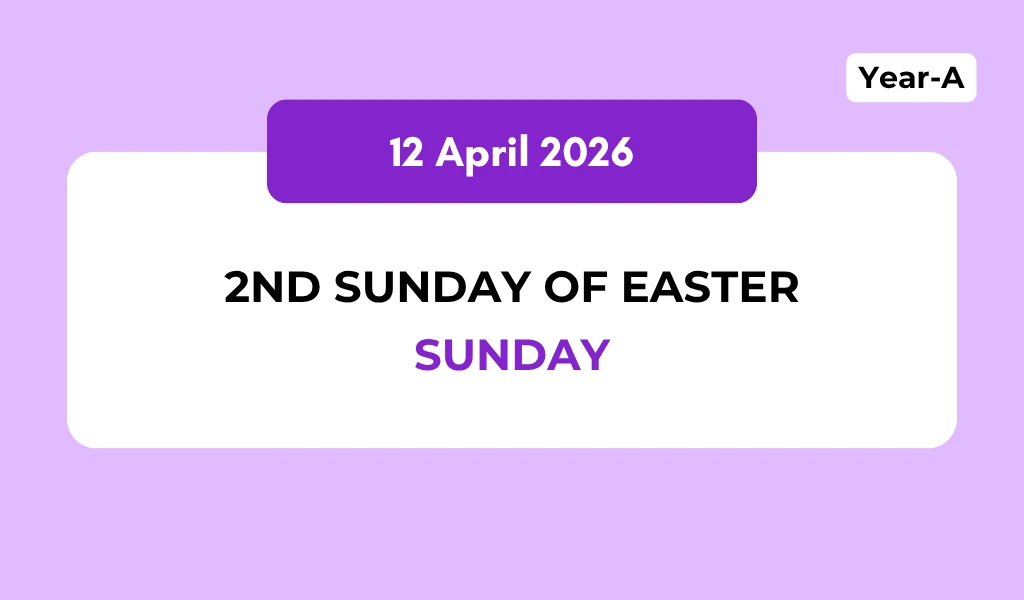
Catholic Mass Readings and Reflection April 12, 2026
Sunday – Divine Mercy Sunday
12th April2026 (Sunday)
Psalter: Proper
Readings of the Day
First Reading: Acts 2:42-47
[The brethren] devoted themselves to the apostles’ teaching and the fellowship, to the breaking of bread and the prayers. And awe came upon. every soul, and many wonders and signs were being done through the apostles. And all who believed were together and had all things in common. And they were selling their possessions and belongings and distributing the proceeds to all, as any had need. And day by day, attending the temple together and breaking bread in their homes, they shared their food with glad and generous hearts, praising God and having favour with all the people. And the Lord added to their number day by day those who were being saved.


Psalm 118:2-4, 13-15ab, 22-24 (R. 1)
R/. Give praise to the Lord, for he is good; his mercy endures forever
Second Reading: 1 Peter 1:3-9
Blessed be the God and Father of our Lord Jesus Christ! According to his great mercy, he has caused us to be born again to a living hope through the resurrection of Jesus Christ from the dead, to an inheritance that is imperishable, undefiled, and unfading, kept in heaven for you, who by God’s power are being guarded through faith for a salvation ready to be revealed in the last time. In this you rejoice, though now for a little while, if necessary, you have been grieved by various trials, so that the tested genuineness of your faith- more precious than gold that perishes though it is tested by fire- may be found to result in praise and glory and honour at the revelation of Jesus Christ. Though you have not seen him, you love him. Though you do not now see him, you believe in him and rejoice with joy that is inexpressible and filled with glory, obtaining the outcome of your faith, the salvation of your souls.
Gospel Acclamation
V/. Alleluia
R/. Alleluia
V/. Have you believed, Thomas, because you have seen me? says the Lord; blessed are those who have not seen and yet have believed.
R/. Alleluia


Gospel: John 20:19-31
On the evening of that day, the first day of the week, the doors being locked where the disciples were for fear of the Jews, Jesus came and stood among them and said to them, “Peace be with you.” When he had said this, he showed them his hands and his side. Then the disciples were glad when they saw the Lord. Jesus said to then again, “Peace be with you. As the Father has sent me, even so I am sending you.” And when he had said this, he breathed on them and said to them, “Receive the Holy Spirit. If you forgive the sins of any, they are forgiven them; if you withhold forgiveness from any, it is withheld.” Now Thomas, one of the twelve, called the Twin, was not with them when Jesus came. So the other disciples told him, “We have seen the Lord.” But he said to them, “Unless I see in his hands the mark of the nails, and place my finger into the mark of the nails, and place my hand into his side, I will never believe.” Eight days later, his disciples were inside again, and Thomas was with them. Although the doors were locked, Jesus came and stood among them and said, “Peace be with you.” Then he said to Thomas, “Put your finger here, and see my hands; and put out your hand, and place it in my side. Do not disbelieve, but believe.” Thomas answered him, “My Lord and my God!” Jesus said to him, “Have you believed because you have seen me? Blessed are those who have not seen and yet have believed.” Now Jesus did many other signs in the presence of the disciples, which are not written in this book; but these are written so that you may believe that Jesus is the Christ, the Son of God, and that by believing you may have life in his name.
Daily Gospel Reflection
Sunday – Divine Mercy Sunday
Main Point: The virtue of divine trust requires us to unlock the doors of our hidden fears, because the resurrected Christ always bypasses our defensive walls to offer us His unmerited peace.
1. In the Gospel today, we find the disciples hiding behind locked doors out of profound fear. They had completely abandoned Christ during His Passion, and now they are paralyzed by their own cowardice, deeply ashamed, and terrified of the outside world.
2. We frequently construct these exact same spiritual fortresses. When we fail the Lord through habitual sin, or when the demands of our Catholic faith feel too difficult, we lock the doors of our hearts and hide behind thick walls of anxiety and self-preservation.
3. But the resurrected Christ does not wait for the disciples to become perfectly courageous or perfectly holy. He completely bypasses their locked doors, stands right in the center of their profound failure, and speaks the words, “Peace be with you.”
4. He does not scold them for their betrayal. Instead, He immediately shows them the wounds in His hands and His side. True divine mercy never erases the reality of our suffering or our sin; rather, the Lord transforms our deepest spiritual wounds into the very instruments of our redemption.
5. Jesus then breathes the Holy Spirit upon them, instituting the Sacrament of Penance. He entrusts the absolute power of absolution to the very men who had just cowardly abandoned Him. God’s mercy is entirely uncalculated and infinitely generous.
6. We then encounter the Apostle Thomas, who stubbornly refuses to believe without tangible proof. We often harbor this exact same spiritual skepticism. We demand strict, measurable evidence and emotional comfort from God before we are willing to completely surrender our intellect and our will.
7. Yet, the Lord is infinitely patient with our human frailty. A week later, Christ returns specifically for Thomas. He invites him to physically touch the sacred wounds of the Passion, meeting Thomas exactly where his faith is weakest.
8. Thomas responds with the ultimate confession of faith: “My Lord and my God!” The moment he encounters the physical reality of divine mercy, his profound doubt is immediately transfigured into extravagant adoration.
9. St. Peter reminds us in the second reading that our faith must be tested by fire, just as gold is purified. Our moments of profound spiritual darkness, fear, and doubt are often necessary to burn away our pride and teach us absolute reliance on the Lord.
10. When we finally allow Christ to unlock our fears, we are called to live like the early Church in the first reading. They broke bread together, shared their possessions without calculation, and lived in profound communal charity.
11. We cannot claim to receive the boundless divine mercy of Christ if we remain locked in our own private, comfortable sanctuaries. True faith demands that we step out from behind our locked doors and extend that exact same unmerited forgiveness to our neighbors.
My Practice: Cultivate the virtue of divine trust today by identifying one specific area of your life where you have locked the door out of fear or spiritual doubt. Consciously surrender that hidden anxiety to the Lord, and make a sincere act of faith in His unfathomable mercy.