
Catholic Mass Readings and Reflection March 13, 2026
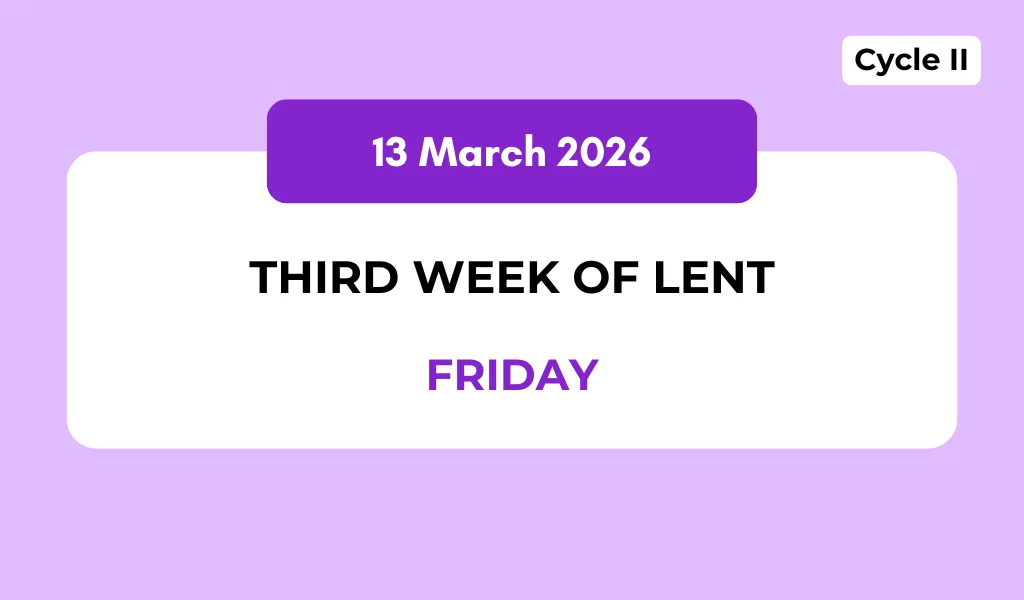
Friday – Third Week of Lent
13th March2026 (Friday)
Psalter: Week 3
Readings of the Day
First Reading: Hosea 14:1-9
Thus says the Lord: Return, O Israel, to the Lord your God for you have stumbled because of your iniquity. Take with you words and return to the Lord; say to him, “Take away all iniquity; accept what is good, and we will pay with bulls the vows of our lips. Assyria shall not save us; we will not ride on horses; and we will say no more, ‘Our God,’ to the work of our hands. In you the orphan finds mercy.” I will heal their apostasy; I will love them freely, for my anger has turned from them. I will be like the dew to Israel; he shall blossom like the lily; he shall take root like the trees of Lebanon; his shoots shall spread out; his beauty shall be like the olive, and his fragrance like Lebanon. They shall return and dwell beneath my shadow; they shall flourish like the corn; they shall blossom like the vine; their fame shall be like the wine of Lebanon. O Ephraim, what have I to do with idols? It is I who answer and look after you. I am like an evergreen cypress; from me comes your fruit. Whoever is wise, let him understand these things; whoever is discerning, let him know them; for the ways of the Lord are right, and the upright walk in them, but transgressors stumble in them.

Psalm 81:6c-8a, 8bc-9, 10-11ab, 14 and 17 (R. see 11a, 9b)
R/. I am the Lord your God: listen to my voice.
Gospel Acclamation
V/. Glory and praise to you, O Christ
R/. Glory and praise to you, O Christ
V/. Repent, says the Lord, for the kingdom of heaven is at hand.
R/. Glory and praise to you, O Christ
Gospel: Mark 12:28b-34
At that time: One of the scribes came up to Jesus and asked him, “Which commandment is the most important of all?” Jesus answered, “The most important is, ‘Hear, O Israel: The Lord our God, the Lord is one. And you shall love the Lord your God with all your heart and with all your soul and with all your mind and with all your strength.’ The second is this: ‘You shall love your neighbour as yourself.’ There is no other commandment greater than these.” And the scribe said to him, “You are right, Teacher. You have truly said that he is one, and there is no other besides him. And to love him with all the heart and with all the understanding and with all the strength, and to love one’s neighbour as oneself, is much more than all whole burnt offerings and sacrifices.” And when Jesus saw that he answered wisely, he said to him, “You are not far from the kingdom of God.” And after that no one dared to ask him any more questions.


Daily Gospel Reflection
Friday – Third Week of Lent
Main Point: We frequently approach our belief system as a tiresome inventory of mandates, whereas God truly desires the sincere surrender of our imperfect selves.
1. Have you ever observed how readily we complicate matters? We do this with our eating plans, our work routines, and most prominently, our spiritual lives. We treat religious observance like a huge, draining to-do list we must complete before God’s grace is given.
2. In today’s Gospel reading, a scribe challenges Jesus to resolve a major debate regarding rules. The established religious authorities had countless strict laws, and constant disputes arose over which rule held ultimate significance. They presumed salvation was a reward earned via perfect behavior.
3. Yet, Jesus disregards all that distraction. He doesn’t present them with a weighty theological text to study. Instead, He provides two remarkably straightforward commands: devote your whole being to loving God, and offer genuine care to your neighbor as you regard yourself.
4. Indeed, the scribe grasps the essence. He affirms that loving God and loving others far surpasses the value of every ritual offering and sacrifice imaginable. He suddenly perceives that God seeks not our flawless performances of piety, but simply he wants our hearts.
5. To be honest, this challenges me because adhering strictly to a list feels secure. We secretly think if we follow all the rules perfectly, we can earn our own redemption. However, authentic, imperfect affection demands complete openness, which is much harder.
6. In the first reading, the prophet Hosea illustrates genuine repentance. God earnestly implores His people to return, not with costly tributes, but merely with sincere speech. He simply wants us to come back home and acknowledge our profound need for His compassion.
7. God guarantees to restore our brokenness and cherish us unconditionally. Salvation isn’t an award for perfect attendance. It is a pure gift for all who dare to give up rigid checklists and just love the people sitting right next to them.
My Practice: Stop evaluating your spiritual journey by a rigid tally of flawlessness. Beginning now, work to train your heart to pause before criticizing yourself or others, and just consider whether your deeds are truly furthering your capacity to love God and your neighbor more effectively.